Transaction scope
Identify the importer, goods, settlement method and applicable permissions.
Find supporting provisions →A guided reading workspace for Bangladesh Bank FEPD-1 Circular No. 30. Start with a transaction checklist, then read the actual source wording.
For each topic, record the applicable provision, required documents, responsible person and follow-up action. The prompts below are study guidance; source text controls any regulatory requirement.
The preserved uploaded copy requires verification against the regulator’s original and subsequent amendments.
Identify the importer, goods, settlement method and applicable permissions.
Find supporting provisions →Match the LC terms, import documents and goods requirements.
Find supporting provisions →Find the applicable security, limit and supporting-document conditions.
Find supporting provisions →Distinguish settlement tenor from financing and confirm the governing provision.
Find supporting provisions →Record the transaction, evidence and outstanding items for reporting and follow-up.
Find supporting provisions →Text extracted page by page from the preserved PDF. All 76 pages are included below. Read the original PDF for table alignment, forms and signatures; later instructions must be read with this circular.
All 76 PDF pages are available below. JavaScript and the research API are not required to read them.
Official file refreshed 20 October 2026. Includes the revised unmatched-IMP restrictions. The circular remains dated 13 August 2026. Preserved earlier copy.
Foreign Exchange Policy Department-1
Bangladesh Bank
Head Office
Dhaka
www.bb.org.bd

FEPD-1 Circular No. 30                             Date: August 13, 2026

All Authorized Dealers in
Foreign Exchange in Bangladesh

Consolidated circular on foreign exchange regulations - import transactions
Dear Sirs,
Please refer to FE Circular No.  33, dated August 14, 2025 in terms of which regulations
governing foreign exchange transactions related to import transactions were issued in a
consolidated form with a validity of one year.
02. FE Circular No.  33, dated August 14, 2025  has been updated by incorporating
subsequent circulars issued thereafter and consolidating them at one place. Accordingly, all
previous instructions shall stand repealed with issuance of this co nsolidated circular, except for
the reporting instructions contained in the Guidelines for Foreign Exchange Transactions (GFET),
Vol.-2.
03. This circular is issued with the authority vested in Bangladesh Bank pursuant to
Section 20(3) of the FER Act, 1947.
04. The instructions of this circular shall remain valid for one year from the date of its
issuance. However, instructions to be issued within this period will be read in conjunction with
this circular.  In case of any ambiguity or inconsistency  arising from the newly incorporated
provisions, the instructions contained in the original circular should be consulted.
Please bring the instructions to the notice of your constituents.


Yours faithfully,

(Md. Harun-Ar-Rashid)
Director (FEPD-1)
Phone: 9530123
i

Contents
Part-A: Import trade
1. Introduction ..................................................................................................................................1
2. Foreign exchange regulations ......................................................................................................1
3. International trade rules ...............................................................................................................1
4. Registration ..................................................................................................................................1
5. Online reporting ...........................................................................................................................1
6. Online reporting for large import .................................................................................................2
7. Import regulatory framework .......................................................................................................2
8. IMP Form .....................................................................................................................................3
9. Dealing with known customers ....................................................................................................3
10. Terms of imports ........................................................................................................................4
11. Imports under special arrangements ..........................................................................................4
12. Use of correct HS Code .............................................................................................................4
13. Amounts for relative import and remittances made thereunder ...................................................4
14. Remittance in excess of the value of the relative import ...........................................................4
15. Imports on FOB basis .................................................................................................................5
Part-B: LC and remittances against imports
1. General .........................................................................................................................................6
2. LC covering imports .....................................................................................................................6
3. Terms on which LCs may be opened ............................................................................................6
4. Import through land ports ............................................................................................................6
5. Period for which LCs may be opened .............................................................................................7
6. LCs to be opened only against firm contracts ..............................................................................7
7. Approved methods of payment .......................................................................................................8
8. Applications for remittances against imports ................................................................................8
9. Remittance of proceeds of dishonored bill ..................................................................................8
10. Remittance against discrepant documents/documents received directly by the importers ........8
11. Remittance against goods imported under penalty ........................................................................9
12. Advance remittance against imports .............................................................................................9
13. Application for remittance on IMP Form ................................................................................10
14. Submission of the authenticated copies of 'Bill of Entry' and 'Certified Invoices' .........................10
15. Extension of time limit for submission of bill of entry etc. .......................................................10
16. Disposal of IMP Forms .............................................................................................................11
17. Acceptance of electronic bill of entry ......................................................................................12
18. Loss of goods ...........................................................................................................................12
Part-C: Import under contracts
1. Imports under purchases/sales contracts without LCs ...............................................................13
Part-D: Imports on supplier’s (deferred)/buyer’s credits
1. Import on supplier’s credit/deferred payment basis ........................................................................14
2. Interest rate.................................................................................................................................15
3. Import on buyer’s credit.............................................................................................................15
4. Payment against usance bills through purchases .......................................................................15
ii

5. Reporting on buyer’s credit .......................................................................................................15
6. Import on longer terms...............................................................................................................15
Part-E: Payment behavior
1. Payment of import liability .........................................................................................................16
2. Payment behavior framework for timely import payments .......................................................16
3. Payment of overdue accepted bills (foreign or local) ................................................................16
4. Documents to head offices/principal offices..............................................................................16
5. Submission of statements ...........................................................................................................16
Part-F: Remittance for software import through e-delivery and other payment
1. Remittance against purchase of software through e-delivery ....................................................18
2. Payment in foreign currency against local supply of goods under international tender ............18
3. Payment of import bills from advance export proceeds retained in FC accounts of ship builder-
exporters .........................................................................................................................................18
Part-G: Back to back LC
1. General .......................................................................................................................................19
2. Opening of back to back import LC .............................................................................................19
3. Inland back to back LCs ............................................................................................................19
4. Opening LC in local currency ....................................................................................................20
5. Payment against back to back LCs ............................................................................................20
6. Stock of inputs procured under back to back LC .......................................................................20
Part-H:
Development and facilitation of alternative trade finance mechanisms………...……………21-22
Part-I:
Pilot framework for digital processing of trade documents under documentary collections and
letters of credit through approved trade corridors……………………………………………23-26
Part-J: Retention of export proceeds for settlement of import payments
1. Retention of foreign currency in single pool for back to back import payments under bonded
warehouse system .............................................................................................................................27
2. Payment of import bills (other than back to back) from direct and deemed export earnings ........27
3. Retention of discounted proceeds ..............................................................................................27
Part-K:
Inland LCs in foreign currencies– Operational modalities………………………………………28
Part-L: Import trade for specialized zones
1. Principles and Procedures ..........................................................................................................29
2. Imports by enterprises operating in specialized zones ...............................................................29
3. Imports on account of zone enterprises .....................................................................................29
4. Import payments matching with export proceeds ......................................................................29
Part-M: Framework for import trade into Free Trade Zones (FTZs)
2. Eligible entities for import into FTZs: .......................................................................................31
3. Nature of imports into FTZs:…………………………………………………………………31
iii

4. Treatment of purchase and sale transactions .............................................................................31
5. Tenor of import transactions ......................................................................................................31
6. Financing and exposure treatment .............................................................................................32
7. Risk management and due diligence..........................................................................................32
Part-N:
Forward Rate Agreements to hedge interest rate risk against imports under suppliers’/buyers’
credit…………………………………………………...……………………………………..33-34
Part-O: Import of gold, silver, jewellery and currency notes
1. Definition of Gold and Silver ....................................................................................................35
2. Import of gold and silver............................................................................................................35
5. Definition of jewellery and precious stones ...............................................................................35
6. Import of jewellery and precious stones ....................................................................................35
7. Import of securities ....................................................................................................................35
8. Import of foreign currency notes and coins ...............................................................................35
9. Purchase of foreign currency from digital wallets of incoming tourists/passengers .................37
10. Bringing in jewellery by incoming passengers ........................................................................38
11. Import for jewellery under export scheme ...............................................................................38
Part-P: Deposit of counterpart fund in respect of imports Under non-project commodity
loans/credits/grants
1. Clean documents against LC Counterpart .................................................................................39
2. Documents against LC received on collection basis/negotiated under reserve due to
discrepancy ....................................................................................................................................39
3. Documents received direct by the ERD or designated banks without opening of LC ..............39
4. Application of rate of exchange .................................................................................................40
5. Penal interest ..............................................................................................................................40
iv

APPENDICES
APPENDIX 1 IMP Form
APPENDIX 2 The area where the importer is resident
APPENDIX 3 ADs should also issue a certificate to the importers
APPENDIX 4 Form of Undertaking.
APPENDIX 5 Bill of entry/customs certified invoice
APPENDIX 6 Monthly summary statement of overdue accepted bills.
APPENDIX 7 Monthly statement of overdue accepted bills -Local payables
APPENDIX 8 Monthly statement of overdue accepted bills -Foreign payables
APPENDIX 9 Monthly statement of overdue accepted bills -Local receivables
APPENDIX 10 Monthly bank -wise summary statement of local overdue accepted
bills.
APPENDIX 11 Payment in foreign currency against local supply of goods under
international tender.
APPENDIX 12 Forward Rate Agreements (FRAs) Weekly Report
APPENDIX 13 Monthly Return on Forward Rate Agreements (FRAs)
APPENDIX 14 General permission by Bangladesh Bank allowing an incoming
passenger to bring into Bangladesh gold or silver in bullion/ingot
APPENDIX 15 Notification No. FE-1/09-BB dated 4th August, 2009
APPENDIX 16 Notification No. FE-01/2017-BB dated 15th October, 2017
APPENDIX 17 Foreign Exchange Declaration Form (FMJ Form)
APPENDIX 18 Statement of L/Cs opened under loans/credits/grants requi ring
deposits of counterpart taka
APPENDIX 19 Statement of discrepant bills received on collection
basis
APPENDIX 20 Statement of deposit of counterpart taka funds.
1

Part-A
Import trade
1. Introduction
Import of goods into Bangladesh is regulated by the Minis try of Commerce in terms of the
Import and Export (Control) Act, 1950, through the Import Policy Order (IPO) in force and
Public Notices issued from time to time by the Office of the Chief Controller of Imports and Exports
(CCI&E).
2. Foreign exchange regulations
In exercise of the powers under Section 5(1) of the Foreign Exchange Regulation (FER) Act,
1947 Taka was declared convertible for current account payments from March, 1994. Within
the scope of the declaration, general authorization is given to Authorized Dealer (AD) banks
to effect outward remittance against admissible import transactions. AD banks shall conduct
foreign exchange transactions on import in conformity with the instructions contained in this
circular and to be issued by Bangladesh B ank from time to time in exercise of the powers
conferred by Section 20(3) of the Foreign Exchange Regulation Act, 1947. Nothing in the
foreign exchange regulations relieves the importers from the necessity of complying with the
import trade regulations prescribed by the Government and relevant other regulations of the
country such as AML/CFT norms, taxes/customs regulations, etc.
3. International trade rules
ADs shall observe best practices in accordance with applicable international trade rules such as
Uniform Customs and Practice (UCP), Uniform Rules f or Collections (URC), Incoterms  etc.
ADs are required to follow the rules of prevailing UCP for issuing Let ter of Credit (LC )
against import trade.  While executing admissible import transactions under sale s contracts on
documentary collection basis, ADs are advised to observe the latest version of URC. For use of
incoterms, ADs shall consult with the IPO in force. Local regulations will, however, prevail in
case of contradiction.
4. Registration
In terms of th e Importers, Exporters and Indentors (Registration) Order, 2023 no person can
import goods into Bangladesh unless he/she is registered with the CCI&E or exempted from the
provisions of the said Order.
5. Online reporting
In addition to other reporting requir ements to Bangladesh Bank, ADs shall report all types of
permissible import transactions to the Online Import Monitoring System  (OIMS) of
Bangladesh Bank on daily/regular basis. ADs shall also observe the following reporting
procedures for relevant import transactions:
(a) Before establishment of LCs or initiation of permissible imports, ADs shall obtain
underlying indents, proforma invoices, purchase or sales contracts from relevant importers.
(b) For imports on FOB or similar other terms, ADs shall obtain appli cable transport charges
against the shipments to facilitate issuance of certificate as per paragraph 15 of this part.
(c) ADs shall provide primary import information based on ( a) above to the OIMS  of
Bangladesh Bank.
2

(d) In case of permissible imports without LCs  by industrial imports, and commercial imports
within authorized limits, ADs shall report to Bangladesh Bank as per (c) above with
indication of imports without LCs.
(e) ADs shall report information from commercial invoice and other relevant documents 1
following the procedures uploaded in Documents  > Other Documents/Guidelines  >
Commercial Invoice Data Entry/Upload Manual of OIMS.
6. Online reporting for large import
For import exceeding value of USD 3.00 million and above or its e quivalent, ADs shall report
to the OIMS of Bangladesh Bank  before 24 hours of opening of LC. The report excl udes
imports by the Government.
7. Import regulatory framework
(1) ADs shall, while providing primary information to the OIMS of Bangladesh Bank , be
ensured of the import price contracted for import depicting the current market price of the
importable goods.
(2) Before opening of LC or initiating imports, ADs shall have to take usual and reasonable
cautionary measures to ensure that both the exporter and importer are bonafide business
persons of the goods concerned, the exporting country is the usual exporter of the goods
concerned and the price of the goods concerned is competitive in terms of prevailing price
in the international market on the date o f contract and/or similar imports in contemporary
period.
(3) To facilitate the accurate verification of the import price in line with international market
rates, the following details need to be clearly mentioned in the Proforma Invoice (PI) sent
by foreign exporters or in the indent provided by their local agents regarding the imported
goods:
(a) A complete description of the goods, including their quality, brand, production date,
packaging information, and grade (if any), through which quality of goods can be
differentiated, as well as the unit price and quantity;
(b) In cases where multiple products are imported through the same PI, the details of each
product should be separately listed, including its description, quality, brand, production
date, packaging details, and grade (if any), with unit price and quantity for each;
(c) In cases where different types of goods are imported under the same PI, all goods
should not be measured in a single unit such as kg, liter, or piece; instead each item
should be presented in the applicable units based on their nature;
(d) Transportation charges should be clearly mentioned in terms of incoterms used for the
relevant transactions;
(e) To identify the imported goods specifically, the 6 -digit HS Code along with the next 2
digits (total of 8 digits) should be mentioned.

1FEOD Circular No. 01, dated October 15, 2025
3

8. IMP Form
(1) Payment against import is subject to declaration by the importer on IMP Form ( Appendix-
1). The importer should read carefully the instructions contained in the IMP Form and shall
declare that:
(a) the applied payment is due and they have not already obtained exchange for payment of
(any of) these goods, nor they have made any other application for that purpose,
(b) the amount of foreign exchange represents the correct prevailing market price for the
goods on the date of contract in country of export,
(c) they are neither connected with the exporters abroad directly or indirectly nor they have
any financial or other interest in the exporters abroad.
In cases of intercompany transactions conducted with par ent companies, approved
foreign subsidiaries, or legitimate branch offices abroad, the importer shall, in lieu of
the declaration mentioned at (c) above, provide a declaration to the effect that:
(i) the transaction is conducted on an arm’s length basis reflec ting competitive market
price; and
(ii) all applicable transfer pricing regulations and other relevant laws, including
AML/CFT standards, are duly complied with.
ADs shall obtain the above declaration from the respective importers prior to initiating
import transactions. ADs shall also satisfy themselves, on the basis of appropriate
documentary evidence, regarding the legitimacy of the relationship between the impo rter
and the exporter abroad.
(2) The IMP Form needs to be attached with the original customs certified Bill of Entry
evidencing the import of the goods which has already been cleared for consumption in
Bangladesh. In other case, importer shall undertake to c lear the goods for consumption in
Bangladesh within four months of the date of the application for payment and shall, before
the expiry of that period, produce to ADs the original customs certified bill of entry
covering the above goods.
(3) ADs should ensure that the registration number of the importer is invariably furnished on
the IMP form. Where the importer is exempted from such registration, a suitable mention
of this fact should be made on the IMP Form.
(4) Details of amounts remitted, whether under LC or ot herwise, should be endorsed on the
relative IMP form.
(5) Before delivering the import documents to the importers, ADs should invariably endorse on
the invoices accompanying the bills the amount, both in figures and words that they have
remitted from Banglades h. The endorsement should be under the seal and signature of
ADs. In case of payment on deferred/usance basis, the amount for which the bill has been
accepted should be endorsed in the invoices.
9. Dealing with known customers
ADs must ensure that they deal o nly with customers having a place of business in Bangladesh
and maintaining accounts with them. They shall also be traceable easily should any occasion
arise for this purpose. Initiation of import trade and payments for imports into Bangladesh
should be made through an AD in the area where the importer is resident ( Appendix-2 lists the
4

areas for foreign exchange regulation purposes). In case the importer is a new customer, AD
should obtain certificate from the AD through which the applicant imported earlier to the effect
that no bill of entry is overdue for submission by the importer. The same should be d uly
verified by the AD through the OIMS of Bangladesh Bank and recorded accordingly.
10. Terms of imports
Appropriate Incoterms should be incorporated in the letter of credit/purchase contract in
compliance with the IPO in force. Import shall usually be made on CFR/CPT basis (as the case
may be). However, import on FOB basis shall be subject to the provisions mentioned in
paragraph 15 of this part.
11. Imports under special arrangements
Specific procedural instructions regarding imports under special arrangements or agreements
(grants, loans, barters etc.) issued by Bangladesh Bank from time to time should be follo wed
by ADs.
12. Use of correct HS Code
It is mandatory to use the correct HS Code to indicate the classification of goods to be
imported, as per First Schedule of the Customs Act. No bank shall initiate import transactions
without quoting correct HS Code in the LC or purchase contract/PI (as the case may be). Failure
to do so may lead to imposition of penalties by the Customs Authority. In all cases of doubt,
reference should be made either by ADs or the customer direct ly to the concerned customs
authority.
13. Amounts for relative import and remittances made thereunder
(1) The aggregate amount of foreign exchange sold against an import whether under LC or
otherwise, should not exceed the value mentioned in underlying documents, in case where
import was initiated and  remittance is needed in a floating currency against which no
forward booking has been made, the Taka value of the amount shall be deemed to have been
increased to the extent of appreciation of the foreign currency for the purpose of allowing
remittance by ADs.
(2) Applicable exchange rate on retirement of import bill: Import bill, unless forward cover
has been taken, shall be retired at the rate of exchange prevailing on the date of lodgment in
the book of ADs.
14. Remittance in excess of the value of the relative import
(1) Remittance in excess of the value of the relative import is not permissible without prior
approval of Bangladesh Bank except for payment of normal bank charges of the foreign
correspondents. In other words, ADs need not adjust the am ount of bank charges from the
import value. Remittances of bank charges should be reported to Bangladesh Bank as
usual with TM forms and necessary supporting documents. ADs shall endorse the amount
of bank charges remitted along with the date of remittance  on the back of the IMP Form.
They should also quote the approval number and date, if remittance is effected against any
specific approval from Bangladesh Bank.
(2) Bank charges of unusual nature i.e., not commonly attributable to transactions against LCs
cannot be remitted without Bangladesh Bank's approval. Foreign bank charges in respect of
5

imports in the public sector shall be on the suppliers account and, hence, cannot be remitted
from Bangladesh. Bank charges under barter/special trade arrangements (STA) shall be
payable in accordance with the relevant provisions therein.
15. Imports on FOB basis
In case of import on FOB basis, AD banks may at the request of their importer clients make
payments of freight/transportation charges in Taka or in equivalent foreign  exchange to
shipping companies/airlines/eligible licensed freight forwarders, out of the total import value
covering costs of goods and transportation charges. The receipts in foreign exchange will be
deposited in foreign currency accounts maintained by t he shipping companies /airlines/eligible
licensed freight forwarders for settlement of overseas payments as per relevant instructions in
this regard. In case of FOB imports, AD should endorse, beside FOB value, the transportation
charges payable in foreign currency or in equivalent Taka as indicated in the bill of lading, etc.
along with miscellaneous charges, if any, as indicated in the airway bill. ADs should also issue
a certificate to the importers in the form given in Appendix-3 to the effect that the amount of
transportation charges etc. has been endorsed on the relative import. The issue of this
certificate is essential as the shipping companies/airlines, etc. is under instructions not to accept
payment of freight in Taka or FC unless the above-mentioned certificate is produced to them.
Moreover, ADs shall not deposit the amount in their FC accounts designated for outward
payment on account of surplus earnings/for eign liabilities without this certificate. However,
payment of transportation charges against FOB import through chartered ship is subject to
compliance of relevant instructions. In cases where the FOB value and the amount of
transportation charges payable  in Taka or foreign currency  exceeds the value of the relative
import, the application should be referred to Bangladesh Bank for consideration with full
particulars and supporting documentary evidence.
6

Part-B
LC and remittances against imports
1. General
ADs may issue, advise, notify or confirm any LC, authority to purchase, guarantee or similar
undertaking covering imports into Bangladesh the implementation of which would involve a
payment in Taka to a non-resident account or a payment in foreign currency in accordance with
the instructions prescribed hereunder.
2. LC covering imports
ADs should establish LCs against specific authorization only on behalf of their own customers
who maintain accounts with them and are known to be participating in the trade. Payme nts in
retirement of the bills drawn under LCs must be received by ADs by debit to the account of the
concerned customer or by means of a crossed cheque drawn on the drawee's other bank. These
restrictions shall not apply to import of articles for the priv ate use of the importer as permitted
in the IPO in force.
3. Terms on which LCs may be opened
(1) Documentary Credits:  All LCs and similar undertakings covering imports into
Bangladesh must be documentary LCs and should provide for payment to be made against
full sets of onboard (shipped) bills of lading, air way bill, railway receipts, truck receipts,
post/courier parcel receipts showing despatch of goods covered by the credit to a destination
in Bangladesh. All LCs must specify submission of signed invoices and certificates of
origin. If any particular import requires submission of any other document or the
remittance of exchange at certain periodical intervals or in any other manner, the LC should
incorporate those instructions.
(2) Screening of underlying import shipments: ADs should, at their own discretion, conduct
the tracking of shipments for relevant import transaction s through vessel/container tracking
system recognized by competent authority
(3) LCs requiring prior permission: It is not permissible to open clean or revolving or standby
letter of credits or LC with realization clause (except EPZ/EZ/HTP companies). Applications
for opening such LCs should be referred to Bangladesh Bank with full particulars.
(4) Transferable LC s: ADs may open transferable LCs for imports into Bangladesh. They
may also allow without reference to Bangladesh Bank amendments that do not violate
foreign exchange regulations and the IPO in force.
(5) Opening of LC s for imports from countries banned by the competent authority:  It is
not permissible to open import LCs in favor of beneficiaries in countries from which
imports into Bangladesh are banned by the competent authority.
4. Import through land ports
For import through land ports,  following instructions are to be followed by ADs while
importing through land ports:
(a) Only one port of entry (land port) is to be mentioned specifically in the LC/purchase contract
(as the case may be);
7

(b) Specimen signatures of the officials working in the import-export desks of the concerned AD
bank, contact phone and fax nos. of ADs are to be sent to all the land ports;
(c) ADs may follow usual procedure to m atch import payment with bill of entry as per
stipulation of paragraph 17 of this part. This procedure shall be applicable only for those
land custom houses using electronic system (ASYCUDA) for import clearance.
(d) LCs/purchase contracts shall contain inter  alia the following payment terms instead of
reimbursement authority/debit authority:
"Upon receipt of documents complying with credit terms, we shall effect payment as per
instructions of Negotiating Bank/Collecting Bank".
(e) LC covering value more than USD 5000 (more than USD 10,000 in case of coal import) or
equivalent should be sent through SWIFT or other similar arrangements to the advising
bank;
(f) NOC (if any) shall contain name of the officials along with P.A. nos. and official seal.
5. Period for which LCs may be opened
LC covering import of goods into Bangladesh should be opened within the period, if any,
prescribed in the IPO in force.
6. LCs to be opened only against firm contracts
(1) ADs should, before opening an LC, see documentary evidence that a f irm order for the
goods to be imported has been placed and accepted. While opening an LC, ADs should
ensure that full description of the goods to be imported are given in each credit along with
the unit price of the merchandise.
(2) Credit Reports of the foreign suppliers:
(a) ADs should also obtain confidential report on the exporters from their branches or
correspondents abroad or in their discretion, satisfy themselves as to the standing of the
exporter by consulting standard books of reference issued by intern ational credit rating
agencies acceptable to ADs in all cases where the amount of LC/contract exceeds USD
30,000 (Thirty thousand) against proforma invoices issued directly by foreign suppliers
and USD 40,000 (Forty thousand) against indents issued by loca l agents of the foreign
suppliers. In respect of indents from local agents, ADs need to satisfy themselves that
the respective agents are regular in repatriation of commission income through the
information from importers. In case of own customers, ADs sha ll check their own
records for satisfaction.
(b) Head Offices/ Principal Offices of all ADs shall maintain a central database of collected
reports and allow their ADs to use the relevant credit reports of the foreign suppliers
stored in the said database. Such reports should be obtained by ADs themselves and the
reports if submitted by the importers should not be accepted. ADs may also, at their
discretion and in their own interest, verify the standing of the beneficiaries even in
cases where the value of the c redit is lower than the limits mentioned above. Credit
report may remain valid for a period of maximum twelve months from the date of
issuance if no adverse report comes to the notice of ADs. Moreover, credit report of the
same supplier collected for one i mporter may be used for other importers within the
same validity.
8

(c) ADs shall obtain the credit report for a supplier during the period of its validity. In no
way, ADs are allowed to remit more than one time as collection cost for the credit
report. During t he validity, ADs shall use the report for all their importers importing
from the same supplier.  Depending on its usability, ADs shall set reasonable service
charges attributable to respective importers. In addition, ADs shall accept credit report
arranged by importers from other ADs. In this case, ADs need to receive the reports
directly from other ADs concerned.
7. Approved methods of payment
LC may be established providing for payment to the country of origin of goods or any other
country except those countries imports from which are prohibited. The LC may provide for
payment or reimbursement in any freely convertible foreign currency including Chinese Yuan
(CNY), in the currency of the country of the beneficiary or of the country of origin/shipment of
goods, or by way of credit to the non-resident Taka account  of the concerned bank abroad.
Payments for imports under barter agreements or under foreign loans/grants can be made only in
the manner specified for the concerned barter/loan/grant.
8. Applications for remittances against imports
ADs may approve on behalf of Bangladesh Bank remittance against imports into Bangladesh
provided the conditions set out in Part-A and elsewhere in this circular are complied with and
provided also that the documents covering the import, whether under LC or otherwise, are
received through ADs concerned. In case of import by post/courier, ADs may make remittance
without prior approval of Bangladesh Bank only if the parcel is addressed directly to ADs.
Where the parcel is addressed to an individual care of ADs/ to the individual direct, prior
approval of Bangladesh Bank should be applied for.
9. Remittance of proceeds of dishonored bill
An AD should not remit the proceeds of bills in cases where the name of the importer on the
bill of exchange differs from the information available in Bangladesh Bank online reporting
system. Where goods are imported under documentary colle ction (DP or DA) basis or even
under LC and the original drawee dishonors the bill and the foreign shipper or his local agent
finds another buyer for the goods, ADs may make the remittance with prior permission of
Bangladesh Bank provided that the goods ha ve released from the customs authority evidenced
by bill of entry.
10. Remittance against discrepant documents/documents received directly by the importers
(1) ADs may consider discrepant import bills, waived by importers under reasonable grounds
acceptable to AD s, as eligible for payments provided that such waivers will not result in
material changes as outlined in paragraph 16(3) of this part. This provision is also
applicable for document received directly by respective importers.
(2) ADs shall conduct due diligence before issuance of shipping guarantees/airway
releases/delivery orders, for the release of respective goods, against 'copy documents'
received directly by importers so that there creates no question to raise discrepancies on
original documents.
9

11. Remittance against goods imported under penalty
An AD may not make remittance in payment of goods imported under penalty. All applications
for remittances of foreign exchange covering such imports should be submitted to Bangladesh
Bank for prior approval and should be accompanied by the attested copy of the Customs Bill of
Entry for consumption in Bangladesh, the relative penalty order together with full particulars of
relevant circumstances.
12. Advance remittance against imports
Advance remittance for permiss ible imports of goods and services into Bangladesh may be
effected by ADs without prior approval of Bangladesh Bank, against applications from the
importers submitted with signed undertaking in the format of Appendix-4 provided that:
(a) the purchase contract with supplier specifically requires advance payment;
(b) the supplier furnishes repayment guarantee acceptable to ADs from a bank abroad, to be
invoked for refund of the amount paid in advance in the event of the suppl ier's default in
delivering the goods or services as per contract. Such guarantee need not however be
insisted upon in cases of advance payments up to USD 20,0002 for import all permissible
imports subject to compliance of the following instructions:
(i) ADs s hall have to be ensured that the applicant -importers do not have bill of
entry/customs certified invoice pending for submission beyond the stipulated period
of four months (or such extension as permitted by Bangladesh Bank) against any
earlier remittance for imports;
(ii) ADs shall have to be satisfied that repayment guarantee is not obtainable from the
suppliers against the remittances to be made in advance;
(iii) ADs shall, at their own responsibility, have to arrange for repatriation of the
remittances made in ad vance in case the entry of goods into the country is not
effected within the stipulated time;
(iv) The IPO in force shall have to be meticulously followed;
(v) Before effecting the advance payment, ADs shall obtain Form of Undertaking
(Appendix-4) duly filled in and signed by the importer.
(c) Advance payments against permissible imports may also be executed directly by external
financiers and/or offshore banking operations of scheduled banks, subject to repayment
guarantees irrespective of amount acceptable to ADs received from banks abroad and
compliance of other relevant instructions contained herein. In this context, ADs shall
observe extended due diligence with regard to the transactions including KYC and
AML/CFT standards. ADs shall als o satisfy themselves regarding the enforceability of
repayment guarantees.
(d) Requests for advance remittance where the suppliers are unwilling or unable to furnish the
repayment bank guarantee referred to in paragraph 12(b)(ii) above may be forwarded by
ADs, along with their recommendations, for the specific decision of the Foreign Exchange
Policy Department-1, Head Office or other offices of Bangladesh Bank on the merit of each
case.

2FE Circular No. 35, dated September 23, 2025
10

(e) ADs shall report to Bangladesh Bank the cases where the goods/services against advance
payments are not received in Bangladesh within due time.
(f) In addition to usual reporting to Bangladesh Bank, ADs  shall preserve (i) undertaking (as
per Appendix-4) (ii) repayment bank guarantee provided by bank abroad (iii) credit report
of the guarantee providing bank abroad for the inspection as and when required by
Bangladesh Bank, Head Office mentioning the probable date of import of goods/services.
However, advance payment for import from ER Q account may be done as per paragraph
2(4) of Part-O of FEPD-1 Circular No. 26, dated July 30, 2026.
13. Application for remittance on IMP Form
(1) IMP Form  for private imports:  All applications for payments against imports into
Bangladesh (including imports from EPZs/PEPZs/EZs/HTPs) should be made on IMP forms.
The IMP forms must be submitted by the importer or his duly authorized representative. In
cases where empowered to approve the remittances on behalf of Bangladesh Bank, AD s
shall endorse its approval on the reverse of the IMP form in the space provided for the
purpose. In other cases, ADs shall submit the IMP form together with required supporting
documents to Bangladesh Bank for approval.
(2) IMP Form for Government imports:  ADs should mark with a bold letter "G" the IMP
form for remittance against an import in the name of a Government department or office
for which LCs are opened by ADs.
14. Submission of the authenticated copies of 'Bill of Entry' and 'Certified Invoices'
(1) Time for submission from date of remittance: In all cases of remittances for imports into
Bangladesh, the importer must submit within 4 months from the dates of remittances the
relevant authenticated copy of the customs bill of entry. In case of import by post/ courier,
the importer must submit the invoice cert ified by the Customs Authority  in lieu of the
authenticated copy of the bill of entry. Where the value of an import by post/courier is less
than GBP 5 or its equivalent in other foreign currency, the custom s authority will issue a
certificate instead of certifying the invoices. In such cases, the certificate may be
submitted in place of the certified invoices.
(2) Bill of entry against import on supplier’s credit (usance/DA) term: In case of import on
supplier’s credit (usance/DA) term, the prescribed period of four month for submission of
bill of entry will be calculated from the date of acceptance of import documents.
(3) Bill of entry against import on buyer’s credit/external credit:  In case of import under
buyer’s credit/external credit, submission of documentary evidence in support of imports
will also be four months of payment by foreign lenders.
15. Extension of time limit for submission of bill of entry etc.
Applications for extension of the time limit beyond fou r months in cases of genuine
difficulties, such as delay in the arrival of the ship or difficulties in clearing the goods already
landed at a port in Bangladesh etc. shall have to be forwarded to Bangladesh Bank (Foreign
Exchange Operation Department  (FEOD), Head Office or other offices ) for consideration
mentioning clearly the concerned IMP Form No. & LC/Contract no. (as reported to the OIMS).
11

16. Disposal of IMP Forms
(1) To effect remittance against import, ADs shall endorse this approval on the reverse of the
IMP Form in the space provided for the purpose. Immediately after import payment, ADs
shall make report to the OIMS of Bangladesh Bank. Besides, import payment shall be
reported in usual monthly returns to Bangladesh Bank wi thout attachment of IMP Form.
ADs shall continue to hold IMP Form until the customs certified bill of entry is received.
During this stage of non -receipt of customs certified bill of entry, ADs shall, on demand,
submit the IMP Form and full set of import documents to Bangladesh Bank.
(2) When the authenticated copy of the bill of entry/customs certified invoice evidencing entry
of goods into Bangladesh, is submitted by the importer, the particulars therein should be
matched and checked with those in the IMP for m and invoice filed earlier to see if the
merchandise for which remittance was made has been duly received in Bangladesh. ADs
shall report the same to the OIMS after necessary verification. If no material discrepancy is
detected, the case should be considered closed. Afterwards, ADs shall retain the IMP Form
and relevant bill of entry with full set of import documents electronically with  them for
record and eventual inspection for a period of 5(five) years. However, in respect of cases
which are under inves tigation by Bangladesh Bank inspection team/other Government
agencies, the IMP form and full set of import documents including bill of entry shall be
disposed of only after obtaining clearance from the inspection team/Government agency
concerned.
(3) Cases wit h material discrepancy between the particulars of merchandise for which
remittance was made and the merchandise actually received as evidenced by the
authenticated copy of bill of entry/customs certified invoice, should be reported on monthly
basis to FEOD , Head office or other offices of Bangladesh Bank, in proforma as given at
Appendix-5 by 10th day of the following month. I mporter who has failed to submit
authenticated bill of entry or whose bill of entry is not available in Cu stoms electronic
system against any earlier remittance for import within the stipulated time (or within the
extended period allowed by Bangladesh Bank) will be barred from opening new LC
without prior permission of Bangladesh Bank. It will equally be appli cable for import
against admissible advance payment and/or imports under sales contract without LCs. ADs
shall also refrain themselves from amending LCs under which IMP reporting remains
unmatched beyond 4 months from the date of payment.
(4) To resolve the ca ses of unmatched overdue bill of entries (partial or full) due to non -
receipt/short receipt of goods as per LC/Contract/IMP, importers may arrange to receive
the unmatched amount in foreign currency (including associated bank charges) from the
same foreign supplier through banking channel. Once the refund is received from foreign
supplier abroad against non -shipment/short shipment of goods, etc., ADs shall report the
same to the 'Online Inward Remittance Monitoring System'. Afterwards, ADs shall report
to Bangladesh Bank (FEOD, Head Office, Dhaka to mail ID: [email protected]) for
recording the refund information against the concerned IMP number reported to the OIMS.
(5) In case of usual bank charges deducted while on refund transa ctions, ADs shall report the
refunded amount to the ‘Online Inward Remittance Monitoring System’.
(6) Refund against payments made in advance:
12

(a) Refund from legitimate sources irrespective of supplier may be acceptable provided
that: (i) There is bonafide business relati onship between the remitter(s) and the
supplier(s) with  whom the earlier contract/LC was established; (ii ) Remitter (s) will
have to be from FATF compliant countries; (iii) ADs shall satisfy themselves regarding
the authenticity (with reference to   LC/Contract/Invoice) of the transactions and adhere
to KYC and AML/CFT guidelines.
(b) ADs shall submit all such applications through Online Ticketing Module of the OIMS
under the Ticket Category titled ‘Refund of Import Payments’ for adjustment with
respective IMP forms. It is mandatory to mention the relevant LC ID, IMP number and
Inward ID number while issuing such tickets.
(7) In cases of failure of submission of bill of entry due to loss or damage of goods by
accident, or for goods auctioned by customs authority or confiscated by Government, ADs
may, apply to Bangladesh Bank soliciting waiver of reporting of such cases as ‘non -
submission’ in their periodic return to Bangladesh Bank with documentary evidences as per
paragraph 18 of this (as the case may be).
17. Acceptance of electronic bill of entry
ADs may accept bill of entry accessible to them through the customs automated system to
dispose IMP Form on completion of matching formalities. In this context, ADs shall observe
the following instructions:
(a) ADs shall be satisfied with the release of imported goods and the settlement of payment on
account of applicable duties and taxes against the relative import for which bill of entry has
been generated;
(b) ADs shall take a print -out from the system of concern ed bill of entry and preserve it in the
relative import files, up  to the prescribed period, after authentication by their competent
officials for record and eventual inspection.
(c) The option as noted above shall be applicable only for import through custom houses
having automated system for issuance of bill of entry.
(d) The above authorization shall not waive ADs to obtain bill of ent ry from importers due to
non-availability of the same in the customs automated system within/beyond the statutory
period, and ot her regulatory purposes required by Bangladesh Bank or by other relevant
Government agencies.
18. Loss of goods
In the event goods are completely lost, copy of the IMP  Form should be forwarded to
Bangladesh Bank giving full particulars of the loss and the man ner in which the insurance
claim has been collected. In the event of partial loss, the authenticated copy of the customs bill
of entry for the goods actually cleared should be submitted giving full particulars of the loss
and the manner in which the insurance claim has been collected.
13

Part-C
Import under contracts
1. Imports under purchases/sales contracts without LCs
(1) In accordance with the IPO in force and in compliance with the provisions of foreign
exchange regulations, ADs may allow eligible importers to import admissible items
through contracts on usance basis under supplier’s/buyer’s credit. The instructions to be
followed for imports are outlined below:
(a) Imports through the relevant purchases/sales contracts needs to be submitted to
designated ADs for onward submission to Bangladesh Bank online reporting portal as
per paragraph 5 of Part-A;
(b) The usance period shall not exceed the limit as prescribed at paragraph 1 of Part-D;
(c) Before submission of import information in Bangladesh Bank online reporting
platform,
(i) ADs shall be satisfied about past performances of importers;
(ii) ADs shall obtain credit report of foreign suppliers as per prevailing regulations;
(iii) An undertaking needs to be collected from the respective importer to the effect that
they have necessary financing arrangements/appropriate cash flows for settlement
of import liabilities on maturity;
(iv) ADs shall not facilitate imports through purchases/sales contracts in case of any
earlier such import payment remaining unsettled beyond maturity.
(2) Imports are also admissible under purchases/sales contracts for enterprises operating in
specialized zones ( EPZs, EZs, HTPs, and other zones declared by the Government). ADs
should observe relevant instructions stated above against such imports by enterprise of
specialized zones.
(3) Short term external borrowing for imports of admissible goods is permitted within t he cost
ceiling as per paragraph 2 of Part-D and declaration from time to time by Bangladesh
Bank. Importers may arrange short term financing from external sources at such cost. The
financing arrangement may include LCs/SBLCs/guarantee to suppliers by exte rnal lenders.
Short term loans on account of import payments and financing costs may be effected as per
underlying arrangements. General waiver from Section 13(1) of the FER Act, 1947 is
hereby given to importers for issuance of guarantees (other than bank  guarantee/standby
LC) such as corporate guarantee, personal guarantee, third party guarantee, etc. favoring
foreign lenders/importers against admissible imports.
(4) Commercial imports without LCs within the prescribed limit of the IPO in force will be
executable only on document against payment basis, unless otherwise permitted on usance
basis. General permission is hereby given for usance facilities up to 60 days, exclusive of
eligible facilities as outlined at paragraph 1 (1) of P art-D, against commercial i mports of
admissible goods without LCs within the provision of the IPO in force and subsequent
notifications.
(5) ADs shall maintain records of import through contracts with relevant information including
dates of maturity and settlement. Based on the records , ADs will notify importers to settle
the liabilities before maturity. As usual, ADs shall comply with relevant instructions of
foreign exchange transactions including reporting routine and other applicable regulations.
14

Part-D
Imports on supplier’s (deferred)/buyer’s credits
1. Import on supplier’s credit/deferred payment basis
(1) Subject to compliance with other conditions laid down in this part and in the IPO  in force,
import is allowed on supplier’s credit/deferred payment/usance basis in the following cases:
(a) Industrial raw material imports for own use of industrial importers (including back to
back imports discussed in detail in the next section) on up to 270 days usance basis or the
cash conversion cycle, whichever is earlier. Before allowing usance facilities, ADs shall
ensure that the estimated cash conversion cycle 3 reflects a realistic position, based on
the customer’s historical operating and transaction trends. In the case of back -to-back
LC, the usa nce period shall be determined in line with the statutory export proceeds
repatriation period;
Liquefied Petroleum Gas (LPG) is imported in bulk and subsequently bottled in
cylinders for domestic use. As a result, local importers require time for storage, bottling
and related operational processes. It is hereby clarified that LPG shall be treated as an
industrial raw material eligible for import under supplier’s or buyer’s credit.
Accordingly, imports of LPG may be allowed for usance terms of up to 270 days , in
line with the above provisions.
(b) Imports of agricultural implements and chemical fertilizers shall also be eligible under
the same usance terms of up to 270 days4, in line with the above provisions;
(c) Import of spares on up to 360 days usance in all cases;
(d) Import of vessels to be procured for scrapping on up to 360 days usance basis;
(e) Import of life saving drugs  (certified/declared as such by Drugs Administration
Authority) and Ophthalmic Medical Equipment including Intraocular Lens on up to 180
days usance basis;
(f) HR Coil, scrap, pig iron & sponge iron used for manufacturing of flat steel and long
steel under steel industries for being used in own factories on up  to 360 days usance
basis;
(g) Import of unprocessed yarn on up  to 270 days for own use by industrial importers
producing outputs for only local delivery against back to back LCs. This usance period
is usable for imports within the limits of production capacity of the concerned factory
as set by the Department of Textiles or up to delivery va lue realized in foreign currency
in last twelve months, whichever is lower;
(h) Import of Active Pharmaceutical Ingredients (API) and Laboratory Reagents on up to
360 days, subject to imports of inputs duly approved by Directorate General of Drugs
Administration Authority (DGDA);
(i) Import of Heavy Furnace Oil (HFO)/ High Sulphu r Fuel Oil (HSFO) as raw materials
for own use of Power Generating Enterprises  by their nominated entities against
specific approval from Ministry of Power, Energy and Mineral Resources on up to 360
days usance basis;

3FE Circular No. 51, dated December 29, 2025
4FEPD-1 Circular Letter No. 01, dated January 11, 2026
15

(j) Import of empty LPG cylinder by industrial importers for own use on up to 360 days
usance basis;
(k) Import of raw material for Pre-fabricated Steel Structure  industries for these industries
only on up to 180 days usance basis.
(2) ADs may allow their industrial importers to import capital machinery and/or capital goods 5
on usance term of up to 3 years under supplier’s/buyer’s credit. The usance tenure shall
also be applicable to such imports by industrial enterprises operating in ex port processing
zones/private export processing zones/economic zones/hi -tech parks and other areas
designated as specialized zones by the Government.
2. Interest rate
For such deferred payment imports, the prices must be internationally competitive and
usance interest, if any, may bear all -in-cost ceiling per annum at mark-up of 3.00 percent6 over
benchmark rate, e.g., SOFR, Euribor , etc. applicable to the relevant currency for short term
trade finance in foreign exchange.
3. Import on buyer’s credit
Besides trade credit from suppliers, import of items stated above is allowed on buyer’s credit.
The same interest level will be applicable also for buyer ’s credits from foreign banks and
financial institutions arranged through designated authorized dealers of the importers in
Bangladesh.
4. Payment against usance bills through purchases
ADs are permitted to purchase accepted usance or deferred bills and make pa yment, in foreign
currency or to non -resident Taka accounts where applicable, against imports or local
deliveries7 under back -to-back LCs before maturity. In such cases, as payment from LC
applicants remains pending until maturity, these transactions effec tively constitute extensions
of credit facilities to respective parties in Bangladesh. ADs may discount or purchase such
accepted usance/deferred bills based on banker –customer relationships and normal banking
practices, subject to the application of due diligence.
5. Reporting on buyer’s credit
Head/Principal Offices of all AD banks are advised to upload related data on Enterprise Data
Warehouse as usual manner as per the requirements of Statistics Department, Bangladesh
Bank.
6. Import on longer terms
Instructions regarding opening of import LCs on longer usance terms against supplier's credits
obtainable by industrial enterprises in the private sector as per general or specific Bangladesh
Investment Development Authority (BIDA) or Bangladesh Bank’ approval, as the case may be.


5FE Circular No. 50, dated December 10, 2025
6FE Circular No. 10, dated May 11, 2026
7FEPD-1 Circular Letter No. 07, dated May 11, 2026
16

Part-E
Payment behavior
1. Payment of import liability
ADs shall make payment of import liabilities as per their exposure/acceptance on due
date/maturity. Failure in settlement of import liability may result in punitive actions including
revocation of AD license by Bangladesh Bank.
2. Payment behavior framework for timely import payments
(1) ADs need to adhere strictly to their commitments with regard to import payments.
Accordingly, ADs shall follow the payment behavior framework as outlined below:
(a) Before issuing LCs, ADs shall ensure appropriate credit lines available for the
respective importers;
(b) Issuance of LCs on behalf of importers without underlying credit facilities is subject to
adequate cash flows and prospective fund arrangements to cover import payments;
(c) Usance import should be financed through buyer's credit by offshore banking
operations, or by the own fund of ADs in terms of paragraph 4 of Part-D.
(2) ADs are reminded to the effect that failure to settle payments on time is subject to punitive
actions, including personal accountability to the officials responsible for the transactions.
3. Payment of overdue accepted bills (foreign or local)
(a) Non-payment of import bills on time tarnishes the image of the country's banking system
and disrupts a conducive environment for foreign trade by increasing its cost. Considering
these issues, banks shall take the following measures to ensure prompt payment of overdue
accepted bills (foreign or local):
(b) A comprehensive action plan must be taken after detailed review of overdue accepted bills
(foreign or local), including analysis based on factors like  ongoing litigation, presence of
realization clauses, and classification as large industrial enterprises.
(c) Branch-wise performance should be evaluated during the review. Branches with a high
volume of overdue unpaid accepted bills (foreign or local) must be  brought under special
monitoring arrangements.
(d) If any bill under litigation is not payable, the supplier’s bank must be informed
accordingly.
(e) While submitting the monthly report on overdue accepted bills (foreign or local), data must
be verified through the OIMS before submission.
4. Documents to head offices/principal offices
All bills (foreign or local) submitted to AD branch, along with discrepancies and details of
payments made, shall be preserved and sent monthly to the relevant department at the head
office/principal offices.
5. Submission of statements
Banks are required to submit the following statements to FEOD, Bangladesh Bank, Head office
regarding overdue accepted bills through e -mail complying with the instructions mentioned in
Appendix-10:
17

(1) Monthly summary statement of overdue accepted bills (Appendix-6)
(2) Monthly statement of overdue accepted bills -Local payables (Appendix-7)
(3) Monthly statement of overdue accepted bills -Foreign payables (Appendix-8)
(4) Monthly statement of overdue accepted bills -Local receivables (Appendix-9)
(5) Monthly bank-wise summary statement of local overdue accepted bills (Appendix-10)
18

Part-F:
Remittance for software import through e-delivery and other payment
1. Remittance against purchase of software through e-delivery
ADs may effect remittance against purchase of software through e -Delivery subject to
observance of the following instructions:
(a) Customs assessment of the purchases : ADs may allow their customers to arrange customs
assessment of the software after being satisfied from the certificate issued by Bangladesh
Association of Software and Information Services (B ASIS) to the effect that the purchase
of software is genuine and sourced from reliable supplier.
(b) Outward remittances: On receipt of customs assessment order and documentary evidence
of payment of duties/taxes, ADs may effect payment against the purchase of  the software
subject to compliance of the following conditions:
(i) ADs shall be satisfied with the certification/licence issued by the supplier that the
software has already been received by the purchaser;
(ii) ADs shall observe due diligence and comply with AML/ CFT regulations in respect of
the transactions;
(iii) ADs shall keep an authenticated copy of the certification/license issued by the supplier
and report the transactions to Bangladesh Bank with IMP Form procedure.
(c) Application for remittance without the procedur e mentioned above shall require prior
approval of Bangladesh Bank.
2. Payment in foreign currency against local supply of goods under international tender
ADs may establish letter of credit in foreign currency favoring local contractor to implement
work order under international tender. Such LCs established in foreign currency shall be settled
through FC clearing accounts of the concerned banks maintained with Bangladesh Bank. The
facility is equally applicable for sub -contractors/agents/other local suppliers  in terms of NBR
explanation letter of November 13, 2022 (Appendix-11). Foreign exchange thus received may
be retained up to thirty days to settle import payment obligations of the client as mentioned in
paragraph 2 of Part-J.
3. Payment of import bills from advance export proceeds retained in FC accounts of ship
builder-exporters
General authorization has been given to ADs to open FC accounts on behalf of ship builder -
exporters for retaining export proceeds received in advance agai nst ship exports. The balances
of these accounts may be used for input procurements. ADs should comply with relevant
instructions in operating the FC accounts.
19

Part-G
Back to back LC
1. General
ADs may open back to back import LCs against export LCs received by export oriented
industrial units operating under the bonded warehouse system, subject to observance of
domestic value addition requirement (stated in terms of permissible limit of value of  imported
inputs as percentage of FOB export value of output) prescribed by the Ministry of Commerce
from time to time.
2. Opening of back to back import LC
Further to the relevant general instructions in the foregoing sections of this chapter, the
following instructions should be complied with while opening back to back import LCs:
(a) Only recognized export oriented industrial units operating under bonded warehouse system
will be allowed the back to back LC facility. The unit requesting for this facility should
possess valid registration with the CCI&E and valid bonded warehouse license.
(b) The master export LC (against which opening of back to back LC is requested) should have
validity period adequate to cover the time needed for importation of inputs, manufacture of
merchandise and shipment to consignee.
(c) The back to back LC value shall not exceed the admissible percentage of net FOB value of
the relative master export LC (as per prescribed value addition requirement) and t he price
of goods to be imported must be competitive. For computation of net FOB value of a
master export LC, the freight charge, insurance cost and commission if payable by the
exporter shall be deducted from the LC value. If the freight element is not sh own
separately, a certificate from the shipping company or the shipping agent should be asked
for.
(d) The back-to-back import LCs shall be opened on a usance basis for a period in accordance
with the provisions stipulated in paragraph 1(1)(a), Part -D of this  circular. Interest for the
usance period shall not exceed the rate as prescribed at paragraph 2 of Part-D. Back to back
LCs opened against (a) Export Development Fund (EDF) administered by Bangladesh Bank
and/or against (b) balances on Non -Resident Foreign Currency Deposit (NFCD) Accounts
may be on sight basis subject to relevant instructions in this regard.
(e) All amendments of the master export LC should be noted down carefully to rule out chances
of excess obligation under the back to- back import LC.
(f) Back to back import LC should not be opened against LCs received for export under
Barter/STA, without prior approval of Bangladesh Bank.
3. Inland back to back LCs
(1) Inland back to back LCs denominated in foreign exchange may be opened in favor of local
manufacturer-cum-suppliers of inputs, against master export LCs received by export
oriented  manufacturing units operating under the bonded warehouse system, up to value
limits applicable as per prescribed value addition requirement/utilization permit. However,
EXP/IMP Form will not be applicable in such cases unless EPZ/PEPZ/EZ/HTP unit is
associated.
20

(2) Back to back import LC against inland Back to back LC:  Back to back LC may in turn
be opened for import of necessary inputs, against inland back to back  LC in favor of a
local manufacturer-cum- supplier operating under the bonded warehouse system, in
accordance with the instructions, mutatis mutandis, at paragraphs 1 and 2 above.
(3) Opening of LC in FC by exporters operating without bond license:  As per decision of
the National Board of Revenue  (NBR), a manufacturer -cum-exporter operating without
bonded warehouse license, may open usance LC and sight LC (against advance receipts of
export proceeds) denominated in foreign exchange favoring packaging industries ,
manufacturers of hanger and plastic goods operating under bonded warehouse license
against all types of export contracts (sales contract, purchase order, proforma invoice, etc.)
received from abroad.
4. Opening LC in local currency
Hundred percent export-oriented industries/direct exporters shall open and settle inland LC in
foreign currency favoring manufacturer -cum-suppliers in the above cases only. For procuring
inputs from local traders/suppliers, LC shall be opened in local currency only.
5. Payment against back to back LCs
Payment in settlement of usance bill against the back to back LCs shall be made at maturity,
out of proceeds of the relative export repatriated in foreign exchange; the required foreign
exchange will be set aside, out of the export proce eds including payments realized in advance,
in a separate foreign currency account in the subsidiary ledger of ADs. Before making
remittance against the back to back import bill, ADs should see that the authenticated copy of
bill of entry for bond in evide nce of actual arrival of the relative imports has been submitted.
Usance bills against back to back LCs should be settled at maturity even where for some
reason export has not taken place, or where the export proceeds have not been realized or
where the re alized export proceeds net of value addition requirement is not adequate to cover
the back to back import payment. In such cases post facto approval of Bangladesh Bank
(FEOD, Head office or other offices of Bangladesh Bank) will have to be sought for withi n
fifteen days of the following month of effecting the payment, explaining fully the
circumstances of exp ort failure or non -realization/short realization of export proceeds, with
relevant supporting documents. Cases of failure of export against the relative master LCs
should also be reported to the NBR and the concerned Commissioner of Customs so that they
may monitor closely the level of stock of the relative goods in the bonded warehouse. A copy
of the letter to NBR reporting the export failure should be submitted to Bangladesh Bank along
with the application for post facto approval of remittance towards back -to-back import
payment. Also, all applications for post facto approval of such remittance in the event of export
failure and short realization/non -realization of export proceeds should be accompanied by the
authenticated copy of the relative bill of entry evidencing actual receipt of the back to back
imports.
6. Stock of inputs procured under back to back LC
ADs should maintain effective watch on the stock of inputs procured under the back to back
arrangement and of finished products made therewith; any indication of illegal disposal of
stocks from the bond coming to the knowledge of ADs should immediately be reported to the
concerned Commissioner of Customs and NBR.
21

Part-H
Development and facilitation of alternative trade finance mechanisms8
1. Documentary LC arrangements remain an importa nt and widely accepted instrument for
facilitating international trade. At the same time, developments in global trade finance
practices have led to the increasing use of complementary trade settlement and financing
mechanisms, such as Open Account Trade, Documentary Collection, Supply Chain Finance
including factoring, receivables financing, and other structured trade finance solutions. These
mechanisms provide additional options for exporters and may support greater flexibility in
addressing diverse commercial requirements.
2. In order to facilitate the orderly development of a broader range of import trade finance
instruments and to align domestic practices with evolving international standards, alternative
trade finance mechanisms may be adopted gradually alongside conventional LC -based export
transactions.
3. Permissible trade finance mechanisms:  ADs may facilitate the following import trade finance
mechanisms, subject to internal credit policies, due diligence, and applicable foreign exchange
regulations:
(a) Advance payments:  Advance payment against import may be effected regardless of
amount provided that ADs receive repayment guarantees from banks abroad. However,
ADs may effect advance payments up to USD 20,000 or its equivalent (USD 50,000 in the
case of payments from ERQ accounts, as per paragraph 2(4) of Part-O of FEPD-1 Circular
No. 26 d ated July 30, 2026)  without repayment guarantee, under the general permission
available pursuant to paragraph 12(b) of Part-B. Requests for advance payments exceeding
the prescribed threshold without repayment guarantees may be submitted to Bangladesh
Bank for consideration on a case -to-case basis. In urgent cases, ADs may submit
applications to Foreign Exchange Policy Department -1 through email during office hours;
such r equests shall ordinarily be disposed of within 48 hours upon receiving complete
application.
(b) Documentary collection:  Pursuant to paragraph 3  of Part-A, AD banks may facilitate
export and import transactions under Documentary Collection arrangements, includ ing
Documents against Payment (DP) and Documents against Acceptance (DA), in accordance
with internationally accepted practices including compliance with the latest version of the
Uniform Rules for Collections (URC), as well as their internal risk management policies.
In respect of imports conducted under purchase/sales contracts, AD banks may facilitate such
transactions without LCs, subject to compliance with the provisions of Import Policy Order in
force and foreign exchange regulations, as prescribed in  Part-C. In such cases, ADs shall not
assume any payment obligation unless separately contracted.
4. Supply Chain Finance (SCF): ADs are encouraged to develop import-oriented SCF including
buyer’s credit, supplier financing, and payables financing.
(1) ADs may ex tend financing to creditworthy importers for usance imports under
sales/purchase contracts. Alternatively, accepted usance import bills of creditworthy
importers may be discounted by ADs on a non-recourse basis to the supplier, enabling early
realization of export proceeds without imposing additional financing costs on the importer.

8FEPD-1 Circular No. 11, June 11, 2026
22

(2) This facility may be provided in addition to, and without prejudice to, the arrangements
permissible under paragraph 4 of Part-D and subsequent instructions in this regard.
(3) ADs intending to introduce the above SCF structures shall inform the Foreign Exchange
Policy Department-1 of Bangladesh Bank prior to launch and ensure implementation only
after regulatory acknowledgement. The submission shall include product structure, risk
framework, credit assessment methodology, exposure limits, approval hierarchy,
monitoring arrangements, and relevant other pertinent issues.
5. Digital trade facilitation and documentation framework:  ADs are encouraged to adopt
electronic and digitized trade  processing systems to enhance efficiency, transparency, and
operational resilience, and may accept electronic trade documents, including invoices and
transport documents, subject to adequate verification mechanisms, acceptable assessment of
counterparty a nd operational risks, and ensured legal validity and enforceability. Physical
documents may be required where mandated by applicable laws, regulations, or contractual
requirements, where transaction -specific risks warrant enhanced controls, or where legal
enforceability depends on original documents. In this context, instructions as outlined at Part -I
need to be observed.
6. Regulatory and Prudential Requirements:  ADs shall adopt a prudent and risk-based
approach in facilitating non-LC trade finance arrangements and ensures the following:
(a) Robust credit assessment of buyers, importers, and respective parties, as applicable;
(b) Defined internal exposure limits based on approved risk rating systems;
(c) Maintenance of a complete documentation trail for all trade finance transactions;
(d) Continuous monitoring of exposures and settlement performance;
(e) Strict compliance with applicable AML/CFT requirements, foreign exchange
regulations, tax laws, and other relevant regulatory provisions.
7. The provisions of this part are intended to facilitate the gradual diversification of trade finance
mechanisms in Bangladesh. Nothing in this instruction shall restrict the continued use of LCs,
which remain a valid and widely accepted instrument for international trade transactions.
23

Part-I
Pilot framework9 for digital processing of trade documents under documentary collections
and letters of credit through approved trade corridors
1. With a view to further advancing digitalization in cross -border trade and enhancing efficiency,
transparency, and resilience in trade finance operations, Bangladesh Bank hereby introduces a
pilot framework for digital processing of trade documents covering both export and import
transactions under documentary collections and LCs through approved trad e corridors. This
framework aims to support interoperable, secure, and legally reliable electronic trade
documentation, including Electronic Transferable Records (ETRs), in line with evolving
international standards.
2. Scope and coverage: The instructions shall apply to:
(a) Import transactions under documentary collections (DP/DA) governed by latest URC and
eURC Supplement; and
(b) Import transactions under documentary credits governed by UCP in force and applicable
electronic presentation rules (eUCP, where applicable); and
(c) Related trade financing activities involving electronic trade documents within approved
pilot arrangements.
3. Core principles for digital trade documents:  All participants under this framework shall
adhere to the following principles:
(a) Interoperability: Electronic trade documents shall be capable of being issued, transmitted,
received, and verified across different systems without dependency on any single platform.
(b) Technology neutrality:  No specific technology, platform, or vendor shall be man dated,
provided minimum security and functional standards are met.
(c) Decentralized verification: Authenticity and provenance of electronic documents shall be
verifiable independently of the issuing or transmitting system using cryptographic or
equivalent mechanisms.
(d) Data privacy by design:  Sensitive trade data shall remain under the control of the
document owner and shall not be mandatorily stored in centralized or shared systems.
(e) Legal functional equivalence:  Electronic trade documents, including ETRs, shall  be
treated as functionally equivalent to paper documents where they meet applicable legal and
operational requirements.
4. Initiation of pilot trade corridors:
(a) ADs shall approach Bangladesh Bank for concurrence in principle for participation in the
pilot framework and use of digital trade document processing arrangements.
(b) Requests shall specify:
(i) Proposed trade corridor(s) (country/region pair)
(ii) Counterparty banks and institutions
(iii) Type of transactions (LC / Collection / mixed)
(iv) Technology approach and interoperability features
(v) Risk management and compliance arrangements

9FEPD-1 Circular No. 15, dated July 01, 2026
24

(c) Approval shall be granted subject to readiness, safeguards, and compliance with this
framework.
(d) Trade corridors shall be identified to enable controlled, legally aligned and operationally
testable pilot implementation in cross-border environments.
5. Legal and contractual arrangements:
(a) Sales contracts, LCs, and collection instructions shall explicitly provide for electronic
issuance, transmission, and acceptance of trade documents.
(b) Parties shall agree that electronic documents shall be:
(i) Operationally valid and binding
(ii) Acceptable for settlement, acceptance, and delivery purposes within the pilot
framework
(c) Applicable rules (URC 522, UCP 600, eURC, eUCP) shall govern transactions to t he
extent mutually agreed among parties.
(d) ADs shall ensure that ETRs comply, to the extent practicable, with principles consistent
with internationally recognized legal frameworks for electronic transferable records.
6. Electronic documents under documentary collections and LCs:
(a) ADs may process trade documents in electronic form, including but not limited to:
(i) Commercial invoices
(ii) Transport documents (including electronic bills of lading where applicable)
(iii) Bills of exchange / drafts
(b) Where documents constitute E TRs, ADs shall ensure that mechanisms are in place to
preserve:
Singularity: Existence of a unique authoritative version of the document;
Control: Ability to identify and transfer exclusive control to a single holder;
Integrity: Protection against unauthorized alteration, including use of cryptographic methods or
equivalent safeguards.
(c) Unique identifiers (e.g., digital fingerprints or hashes) shall be used where feasible to
ensure document integrity.
(d) Where full electronic handling of title documents is n ot feasible, hybrid arrangements with
physical fallback may be applied.
7. Endorsement, transfer and control mechanism:
(a) Electronic endorsement of documents may be executed through:
(i)  digital signatures;
(ii)  secure platform-based transfer mechanisms; and
(iii) authenticated interbank messaging systems, where required for communication of
settlement instructions, endorsements, or operational messages, particularly where
platform based electronic channels are not available or mutually agreed.
These mechanisms may be used individually or in combination for the issuance,
transmission, endorsement, authentication, and related processing of electronic trade
documents under the approved pilot framework.
25

(b) Platform-generated audit trails and system logs shall constitute evidence of:
(i) Endorsement
(ii) Transfer of control
(iii)Receipt and acceptance
(c) Transfer of ETRs shall ensure that only one party exercises control at any point in time.
8. Import transactions under LC arrangements and sales contracts:
(a) Import transactions under LCs and documentary collection under sales contracts may be
processed with electronic presentation of trade documents, subject to acceptance by the
relevant banks involved, including issuing, advising, nominated banks, or settlement banks,
as applicable.
(b) Where ETRs or electronic trade documents are not legally recognized or enforceable in the
counterpart jurisdiction, ADs may:
(i) accept electronic copies of documents for preliminary verification purposes; and
(ii) require submission of physical documents of title or othe r original documents, where
necessary for compliance, legal enforceability, or risk management.
(c) Release of goods under import transactions may be effected based on mutually agreed
electronic confirmation and verification mechanisms established within the a pproved pilot
framework, subject to compliance with applicable regulatory requirements and contractual
terms between the parties.
9. Technology, security and data integrity:
(a) ADs shall ensure secure transmission channels with:
(i) Encryption
(ii) Authentication
(iii) Time-stamping
(iv) Tamper-proof audit logs
(b) Systems shall comply with internationally recognized information security standards.
(c) Sensitive document data shall not be mandatorily stored in shared or public infrastructures.
(d) ADs shall establish and maintain approp riate digital interfaces, platforms, or secure
channels to enable their customers to electronically submit, access, track, and manage trade
documents and related data flows under this framework. Such interfaces shall ensure data
security, user authentication, auditability, and compatibility with interoperable digital trade
document systems.
10. Use of technology service providers:
(a) ADs may utilize digital trade platforms, service providers, or open-source solutions that:
(i) Support interoperability
(ii) Enable independent verification of documents
(iii)Meet acceptable governance and security standards
(b) Preference should be given to solutions that avoid vendor lock -in and support cross
platform compatibility.
(c) Costs associated with such services may be treated as normal banking charges.
26

11. ADs shall observe usual reporting requirements, including additional instructions based on
pilot outcomes.
12. Implementation:
(a) The pilot framework shall be implemented on a phased basis under approved trade
corridors.
(b) Expansion shall be subject to satisfactory performance and regulatory assessment.
(c) Existing foreign exchange regulations shall remain applicable unless otherwise modified.
27

Part-J
Retention of export proceeds for settlement of import payments
1. Retention of foreign currency in single pool for back to back import payments under bonded
warehouse system
(1) On encashment of export proceeds equivalent to the portion of value addition, residual
portion of export proceeds against different export bills of the same expo rt unit operating
under bonded warehouse system may be maintained in foreign currency in a single pool by
ADs. Such retention can be made out of advance payment. Funds from this pool may be
used for different back to back import payments of the same export ing unit on maturity
basis to keep minimum involvement of AD's own fund under the exchange position as well
as to keep exporter free from debt burden.
(2) ADs may, on applications from exporters, retain value added portion of export proceeds in
foreign exchang e for a maximum period of 30 days. The fund so retained will be used
through same ADs for settlement of other import obligations payable by same exporters
within this period.
(3) ADs are allowed to transfer the unencumbered fund from the pool, not exceeding
permissible portion eligible as Exporter’s Retention Quota entitlement, to other ADs for
bonafide use by exporters and/or their sister concerns as per relevant instructions. As usual,
ADs shall encash the unused fund, if any, compulsorily in Taka just after expiry of 30 days.
2. Payment of import bills (other than back to back) from direct and deemed export earnings
(1) If import bills (other than back to back LC) fall due for payment within 30 days from the
date of receipt of export proceeds including payments realized in advance by the
exporters/deemed exporters, ADs may, on application by the manufacturers-cum-exporters
retain such proceeds in foreign exchange for a maximum period of 30 days for making such
import payments even it exceeds the allowable retention quota limit. However, export
proceeds so retained (in excess of the usual retention quota entitlement) shall be encashed
compulsorily in Taka if the same is not utilized for s uch import payment within 30 days
from the date of receipt. To identify such transactions distinctly, ADs are required to
maintain appropriate register and other necessary records.
(2) Unencumbered balances held in the pool shall, at the request of exporters within the
stipulated time, be useable to meet import payments of exporters’ subsidiaries/sister
concerns, subject to observance of the instructions applicable for fund transfer from ERQ
accounts as per paragraph 2(2) of Part-O of FEPD-1 Circular No. 26, dated July 30, 2026.
3. Retention of discounted proceeds
Discounted proceeds against export/local delivery bills may be retained in foreign currency for
settlement of import liabilities as per paragraph  1 or paragraph 2 above in accordance with the
nature of liabilities.
28

Part-K
Inland LCs in foreign currencies– Operational modalities
1. ADs are permitted to establish inland back to back LCs and other admissible LCs in foreign
currencies in terms of this circular. Operations of inland LCs in foreign currencies are guided
by UCP in force and other international standards, including regulatory instructions issued
from time to time by Bangladesh Bank.
2. Domestic trade in foreign currencies faces bottlenecks due to various clauses embedded in
LCs. These clauses are of ten difficult to be met within the validity of LCs. Examples include
requirements of delivery challans to be signed by top officials of LC applicants, acceptance of
documents by applicants before these are submitted to beneficiaries’ ADs, etc. Domestic
sellers frequently encounter financial difficulties due to prolonged processing time. Despite the
significant volume of transactions, domestic trade activities, including financing by ADs,
remain sluggish and lack vibrancy.
3. To bring ease in domestic trade, A Ds are advised to establish operational modalities that can
simplify domestic trade transactions in foreign currencies. In addition, ADs need to observe
following instructions:
(a) For LC issuing ADs:
(i) ADs shall avoid incorporating conditions in LCs which can not be maintained during
the validity of respective LCs.
(ii) In case of unusual conditions to be imposed by LC applicants, ADs shall examine if
such items are available in purchases or sales contracts/proforma invoices.
(iii) On receipt of documents for payment/acceptance, ADs shall conduct usual formalities
for examining them, and making payments or acceptance, whichever is required; in no
way, they shall forward the same documents to LC applicants for examination and
their acceptance.
(b) For LC advising/nominated ADs:
(i) ADs should examine clauses contained in respective LCs received from LC issuing
banks and advise the same to beneficiaries.
(ii) On receipt of documents from beneficiaries, ADs shall examine the documents and
forward the same for payment/collection to LC issuing ADs.
4. Transactional framework for inland trade needs to be brought under electronic platform.
Accordingly, ADs should introduce electronic options with regard to communication relating
to LCs such as transmissio n, advising, presentation, acceptances and all subsequent
communication under mutually agreed systems with counterparts. ADs shall have safe and
secure electronic systems, duly approved by the Board of Directors (competent management
team in case of foreign banks), compliant with the Guideline on ICT Security in force.
5. ADs shall report the information including acceptances to Bangladesh Bank online reporting
system in accordance with reporting routine, inter alia.
29

Part-L
Import trade for specialized zones
1. Principles and Procedures
Operations of import trade in specialized zones (EPZ/PEPZ/EZ/HTP) are guided by respective
regulations. The following types of industrial enterprises operate in specialized zones:
(a) Type A: 100 percent foreign owned including those owned by Bangladeshi nationals
ordinarily resident abroad;
(b) Type B: Joint venture projects between foreign and Bangladesh entrepreneurs resident in
Bangladesh;
(c) Type C: 100 percent Bangladeshi entrepreneurs resident in Bangladesh.
2. Imports by enterprises operating in specialized zones
(1) IMP Form procedures will not be applicable for intra/inter zones transactions and import
from Bangladesh (Non -zone area). These transactions are to be reported in relevant
monthly schedules with reference to EXP forms issued at export-leg.
(2) National Board of Revenue (NBR) vide its order no. 288/2017/Customs/529 dated
December 21, 2017 effects relevant amendment in the Customs (Economic Zones)
Procedures, 2017 to waive export/import formalities (EXP/IMP) for transactions between
enterprises operating in Domestic Processing Area (DPA) of EZs and in Tariff Area (TA)
of Bangladesh. Accordingly, transactions by DPA enterprises in EZs irrespective of their
ownership status are allowed to settle their liabilities for imports and other permissible
expenses out of the fund held in their Taka accounts. Hence, the restrictions to use AD’s
own fund for import settlement as mentioned in paragraph 3(a) of this part will not be
applicable for EZ enterprises operation in DPA.
3. Imports on account of zone enterprises
(1) In establishing import LCs on account of Type A, B and C enterprises in specialized zones,
ADs shall bear in mind the position that the import payments may be made only out of the
foreign exchange earnings of the concerned units or out of their borrowings abroad credited
in their FC accounts, and that no funds from AD's own foreign exchange resources can be
used for this purpose. Before opening inputs import LC against an export LC or export
order received by zone enterprises, ADs should satisfy themse lves completely about the
clarity of the conditions in the export orders/LCs, the standing and credit of foreign buyers
and the ability of the enterprises for timely execution of export orders.
(2) Type C enterprises shall be allowed to obtain foreign exchange from ADs to settle obligations
for importing capital machinery by the conversion of equivalent amount of equity and/or
authorized loan received in local currency. Similarly, Type B enterprises may be allowed to
convert their local equity/authorized loan received in local currency into foreign exchange to
settle obligations for importing capital machinery if equity/authorized foreign loan received
from abroad falls short to meet such obligations.
4. Import payments matching with export proceeds
Import payments against LCs should be scheduled in a manner that payment obligations do not
fall due before receipt of export proceeds. In all cases of opening inputs import LCs on
30

accounts of enterprises in respective zones, ADs should satisfy themselves that necessary
arrangements have been made by the enterprises that in case of shortfall or delay in export
receipts, foreign exchange would be made available from external sources.
5. Retention of export proceeds for settlement of import liabilities
(1) ADs may allow Type B and Type C industrial enterprises to retain their repatriated export
proceeds in back to back settlement pool in foreign currency in line with the provisions as
per paragraph 1 of Part-J. Accordingly, Type B and C industrial enterprises may:
(a) retain repatriated export proceeds in the settlement pool until back to back payments.
(b) retain the value added portion in the same pool for up to 30 days for settlement of
import liabilities or other admissible payments in foreign currency.
(c) transfer unutilized funds to other ADs for settlement of import liability of exporters or
their subsidiaries/sister concerns operating in specialized zones.
(2) In case of fund remaining unused within 30 days, ADs may transfer the same, after
encashment of at least 20 percent (25 percent for garments sector) of total repatriation, to
foreign currency accounts of respective exporters.
(3) Exporters executing export without back to back basis may retain repatriated export
proceeds in foreign currency for 30 days and utili ze the same in terms of paragraph 2 of
Part-J, including transfer to other ADs to meet import payments of exporters’
subsidiaries/sister concerns operating in specialized zones. Unused fund, if any, may be
transferred to foreign currency accounts of respec tive exporters, on encashment of at least
20 percent (25 percent for readymade garments exports) of total repatriation.
31

Part-M
Framework10 for import trade into Free Trade Zones (FTZs)
1. In order to facilitate import trade into Free Trade Zones (FTZs) and e nsure prudent risk
management by banks, it has been decided to introduce a structured framework governing such
transactions. Accordingly, the following instructions shall be followed by Authorized Dealers
(ADs) and Offshore Banking Units (OBUs) providing f inancial services for transactions
involving FTZs, in line with prevailing foreign exchange regulations.
2. Eligible entities for import into FTZs:
Imports into FTZs may be undertaken by the following entities operating within such zones:
(a) Industrial enterprises engaged in manufacturing, processing, or export-oriented production;
(b) Importers on record authorized to undertake trading activities; and
(c) Logistics service providers duly permitted to operate within FTZs.
3. Nature of imports into FTZs:
(1) Imports int o FTZs for storage, warehousing, or distribution may be undertaken on a
consignment basis, whereby ownership/title of goods remains with foreign supplier s until
such goods are:
(a) used in production; or
(b) sold to ultimate buyers.
(2) For the purpose of bank financing and exposure recognition, such goods shall not be treated
as owned inventory of FTZ enterprises entity until the occurrence of either of the above
events.
4. Treatment of purchase and sale transactions
(1) Purchase of goods from FTZs by buyers in Bangladesh, including those located in
specialized zones or intra/inter FTZs, shall be treated as import transactions. Accordingly,
usual import procedures, including IMP formalities, shall be duly followed.
(2) Where such purchases relate to  industrial raw materials, usance import facilities of up to
270 days may be allowed in terms of paragraph 1(1)(a) of Part-D.
(3) Sale of finished or semi -finished goods by FTZ enterprises to buyers in Bangladesh,
including those in specialized zones or intra/ inter FTZs, shall be treated as export
transactions for sellers and import transactions for buyers. Accordingly, EXP and IMP
procedures shall be complied with by the respective parties.
(4) Payments against all such transactions shall be settled in freely conv ertible foreign
currency. FTZ enterprises may retain sales proceeds in designated margin accounts in
foreign currency for the purpose of onward settlement abroad in respect of underlying
import obligations.
5. Tenor of import transactions
(1) Goods imported into FTZs under consignment arrangements may remain in the zone for a
period of 48 to 60 months , subject to observance of the applicable regulatory requirements
in this regard.

10FEPD-1 Circular No. 21, dated July 16, 2026
32

(2) Usance import transactions, including those supported by buyer’s credit or supplier’ s
credit, shall be subject to a maximum tenor of 270 days, in line with prevailing foreign
exchange regulations.
6. Financing and exposure treatment
(1) ADs may extend financing to FTZ entities in a manner similar to financing facilities
provided to enterprises o perating in specialized zones, as outlined in Part-B of FE Circular
No. 34, dated September 02, 2025.
(2) In respect of consignment -based imports, ADs/OBUs shall not recognize or assume
exposure on the FTZ entity against goods where ownership/title remains wit h the foreign
supplier. Consignment is recognized as imports only upon transfer of ownership to the
FTZ/other entity through consumption in production or sale to ultimate buyers, supported
by appropriate documentation including bill of entry. On transfer o f ownership, credit
facilities may be admissible as per (c) below.
(3) For usance imports, ADs may arrange buyer’s credit or extend supplier’s credit facilities
with a tenor not exceeding 270 days. OBUs may provide such financing in foreign currency
in accordance with applicable regulations as per paragraph 1(1)(a) of Part-D.
7. Risk management and due diligence
(1) Admissible financing shall be supported by appropriate documentation and aligned with the
underlying transactions.
(2) ADs/OBUs shall undertake due diligence on FTZ clients, including assessment of
contractual arrangements with foreign suppliers and buyers, verification of ownership
structure, and evaluation of production and sales cycles.
33

Part-N
Forward Rate Agreements11 to hedge interest rate
risk against imports under suppliers’/buyers’ credit
1. To facilitate effective interest rate risk management for importers availing suppliers’/buyers’
credit in foreign currency as per Part -D and relevant other instructions, ADs may enter into
Forward Rate Agreements (FR As) with their respective importers under following conditions
and features:
(a) Purpose: The FRA shall be used solely for hedging the interest rate risk of the underlying
suppliers’/buyers’ credit. No speculative, leveraged, or uncovered position shall be
permitted.
(b) Eligible transactions: Importers having initiated permissible usance imports under
suppliers’/buyers’ credit within the prescribed rate are eligible to hedge the floating rate
portion of such credit through an FRA.
(c) Contract structure: The FRA is  a notional agreement between importers and ADs to fix an
agreed interest rate for a future period. Settlement under the FRA shall be made in local
currency (BDT) for domestic payment or in the FRA -referenced foreign currency for
foreign settlement, based on the net interest differential between the contracted FRA rate
and the actual realized SOFR for the relevant period. Actual loan repayment does not take
place under the FRA. The notional principal shall not exceed the underlying credit amount;
(d) Tenor: The FRA tenor shall correspond to the remaining interest period of the underlying
borrowings, within the permissible tenure, as specified in paragraph 1 of Part-D.
2. Counter-hedging by ADs:  To ensure that FRAs are used strictly as hedging instruments and
do not results in the build-up of unmitigated market risk on the ADs’ balance sheets, ADs shall
fully offset their FRA exposures on following conditions:
(a) ADs shall not take any market risk into its own books and shall cover the transaction on the
same day on a back-to-back basis with foreign or local counterparties;
(b) Counter-hedging instruments may be settled in foreign currency as per international market
conventions. Foreign -currency inflows or outflows arising from such hedges shall be
permissible strictly for the purpose of neutralizing ADs’ exposure on the related FRA. The
pricing spread retained by ADs in a FRA transaction shall not exceed 10 basis points;
(c) ADs shall maintain full documentation supporting price discovery, justification of the
counter-hedge rate, and linkage of all foreign -currency settlements to the underlying hedge
requirement;
(d) Temporary timing mismatches, if any, between customer FRA settlement and counter -
hedge settlement shall be managed within ADs internal market-risk limits;
(e) AD’s total permissible FRA notional outstanding must be ≤ 25% of its average monthly FX
inflows over the past 12 months.
3. Early termination or cancellation of FRA:  In the event that an importer intends to terminate
an FRA prior to its maturity, the contract shall be closed at the prevailing market rate, and the
importer or ADs shall settle the net difference between the contracted FRA rate and the

11FEPD-1 Circular No. 16, dated July 02, 2026
34

prevailing market rate for the remaining period. ADs shall keep full records of the  market rate
used, the calculation of the close-out amount, and the importer’s written consent.
4. Documentation and compliance:
(a) ADs shall execute the FRA under appropriate ISDA or equivalent documentation together
with a transaction-specific term sheet, clearly referencing the underlying imports. The term
sheet shall specify:
(i) the underlying exposure being hedged,
(ii) the agreed FRA rate, tenor, and notional,
(iii)risk disclosures,
(iv) settlement mechanics and calculation standards.
The ISDA or equivalent documents should be suitably modified as per existing laws and
regulations of Bangladesh.
(b) ADs shall perform daily mark -to-market (MTM) valu ations of all outstanding FRA
positions consistent with IFRS or international market practices to monitor interest rate and
foreign currency risk in real time.
(c) ADs shall maintain full records of all FRA transactions, including ISDA schedules,
confirmations, executed term sheets, computation sheets, MTM valuations, settlement
records, and documents evidencing the underlying exposure, for supervisory inspection.
(d) Customers shall acknowledge and accept the structure, risks, and MTM implications of the
FRA by s igning the term sheet, which shall form an integral part of the transaction
documentation.
(e) ADs shall not offer or encourage FRAs to importers without genuine underlying exposure.
Misrepresentation, misleading advice, or inadequate risk disclosure by ADs l eading to
importers’ loss may result in regulatory action against the respective ADs and officials.
(f) Internal audit department of ADs shall periodically review FRA transactions, including
counter-hedging, for compliance.
(g) ADs shall have Board approved poli cies and procedures on derivative transactions and risk
management framework to identify, quantify and evaluate the exposures, manage risk and
monitor performances related to derivative transactions.
(h) ADs shall ensure that appropriate expertise and capacit y building are in place to engage in
financial derivative transactions.
(i) All FRAs shall comply with KYC, AML/CFT, regulations on taxes and internal risk
management policies of ADs.
5. ADs are required to report each FRA transaction to Bangladesh Bank, FEPD -1 on the last day
of the concern week using the format specified in Appendix-12. Additionally, a consolidated
regular monthly return must be submitted at the end of each month as specified in Appendix-
13.
35

Part-O
Import of gold, silver, jewellery and currency notes
1. Definition of Gold and Silver
Gold, as defined under Section 2 of the FER Act, 1947 includes gold in the form of coin
whether legal tender or not or in the form of bullion or ingot whether refined or not. Silver, as
defined under the same Section of the said Act includes silver bullion or ingot, silver sheets
and plates which have undergone no process of manufacture subsequent to rolling and
uncurrent silver coin which is not legal tender in Bangladesh or elsewhere.
2. Import of gold and silver
In terms of Notification No. 1(2) ECS/48 dated 1st July, 1948 issued pursuant to sub -section
(1) of Section 8 of the FER Act, 1947 Government have prohibited, except with the general or
special permission of Bangladesh Bank, the import into Bangladesh from any place outside
Bangladesh of:
(a) any gold coin, gold bullion, gold sheet or gold ingot whether refined or not, and
(b) any silver bullion, silver sheet or plate which has undergone no process of ma nufacture
subsequent to rolling or any uncurrent silver coin.
3. Import of gold and silver into Bangladesh from any place outside is, therefore, subject to
Bangladesh Bank's general or specific authorization. Bangladesh Bank accords approval,
against applications, to authorized gold dealers in terms of the Gold Policy -2018 (amended)-
2021.
4. In terms of Notification No FE -1/16-BB, dated January 20, 2016 ( Appendix-14), general
permission has been accorded by Bangladesh Bank allowing an  incoming passenger
irrespective of their resident status to bring into Bangladesh gold or silver in bullion/ingot form
up to the prescribed limit in terms of the relevant Baggage Rules in force issued under Customs
Act, 2023.
5. Definition of jewellery and precious stones
The terms jewellery and precious stone are deemed to include all articles made wholly or
mainly of gold, platinum, diamonds of all kinds, precious or semi -precious stones, pearls,
whether or not mounted, set or strung and articles set or m ounted with diamonds, precious or
semi-precious stones or pearls.
6. Import of jewellery and precious stones
There are no restrictions under the FER Act, 1947 on the import of jewellery and precious
stones. However,  import of gold jewellery is to be executed by gold dealers authorized by
Bangladesh Bank within the purview of the Gold Policy-2018 (amended)-2021.
7. Import of securities
There are no restrictions under the FER Act, 1947 on import of securities into Bangladesh.
8. Import of foreign currency notes and coins
(1) In terms of Bangladesh Bank Notification Nos. FE -1/09-BB dated 4th August, 2009
(Appendix-15) and FE-01/2017-BB dated 15th October, 2017 (Appendix-16), any person
36

may bring into Bangladesh from any place outside Bangladesh without any limit foreign
currency notes or bank notes other than-
(a) Un-issued notes and coins.
(b) Notes legal tender in Bangladesh in excess of Taka 10,000 (Ten thousand) in value.
Provided that the concerned person makes a written declaration to the Customs Authority at
the time of arrival in form FMJ ( Appendix-17) of the entire amount; no declaration will
however, be necessary if the amount brought in does not exceed USD 10,000 ( Ten
thousand) or its equivalent in foreign currency and does not exceed Taka 10,000 (Ten
thousand) in notes legal tender in Bangladesh. Each set of form FMJ consists of 3  (three)
copies - the original copy for Bangladesh Bank, the sec ond copy for Customs Auth ority
and the third copy for the concerned passenger.
(2) Sending into Bangladesh by post/courier or otherwise of any currency note, bank note or
coin by any person from abroad without general or specific permission from Bangladesh
Bank is prohibited.
(3) Any traveler entering into Bangladesh may bring with him at every time Bangladesh
currency notes/coins within the limit as prescribed hereunder:
(a) Members of the crew of a ship or an aircraft or the staff of a railway may bring
Bangladesh currency notes up to Taka 10,000 (Ten thousand) at any one time.
(b) An incoming/outgoing passenger may bring in/take out up  to Taka 10,000 (Ten
thousand) in Bangladesh currency at the time of arrival into/departure from
Bangladesh.
(c) Every foreign national travelling on a foreign pas sport and persons travelling on
Bangladesh passports will, while entering into Bangladesh by sea, air or land from any
destination outside Bangladesh declares to the Customs Authorities, on form FMJ to be
completed in one set of Form containing three copie s for all currencies if the amounts
brought in exceed t he limits mentioned at para graph 8(1) above. Transit passengers,
however, are not required to complete this  form. The customs official will return to the
declarant the copy of the form designated for t he passenger duly authenticated.
Authorized Money Changers and ADs need not ask for this form at the time of
encashing the foreign currency and foreign currency instruments to Taka. Foreign
nationals should however retain these declarations with themselves  so as not to face
difficulty in taking out unspent foreign exchange at the time of their departure from
Bangladesh.
(4) Bank booths operating in airports under license with limited scope from Bangladesh Bank
may take deposits from NRBs in foreign currency bro ught in by them for crediting their
foreign currency accounts or Non -Resident Taka accounts (by converting foreign currency
at prevailing exchange rate) maintained with concerned AD bank branches. In case the
foreign currency brought in by NRBs differs fro m account type (i.e., USD A/C, GBP A/C,
etc.) of the account holders, bank booths shall convert the currency into relevant foreign
currency at appropriate cross currency exchange rate to effect the deposits.
An incoming person may retain foreign exchange u p to USD 10,000 or equivalent brought
in by himself/herself without declaration and takes  out the same at the time of departure
from Bangladesh without endorsement in passport and air ticket. Such amounts may also
37

be deposited in RFCD account by a resident  Bangladeshi and in NFCD account/Private FC
Account by a non-resident Bangladeshi any time after arrival in Bangladesh.
Amount in excess of USD 10,000 (Ten thousand), brought in by the resident Bangladeshis,
should however be encashed or deposited in appro priate foreign currency account within
30(thirty) days of arrival. Such amounts brought in by non -resident Bangladeshis can be
encashed or deposited in foreign currency account any time after return to Bangladesh. For
a foreign national, the entire amount brought in with declaration on Form FMJ or up  to
USD 10,000 (Ten thousand) brought in without declaration may be taken out freely at the
time of departure. Such amounts brought in by foreign nationals can be encashed or
deposited in foreign currency account any time after their enter into Bangladesh.
(5) ADs may supplement its holdings of foreign currency notes from abroad with approval
from Bangladesh Bank.
9. Purchase of foreign currency from digital wallets of incoming tourists/passengers
(1) Incoming tourists/passengers can use their international cards brought in with them in
Points of Sales (POS) for shopping. ATM booths facilitate them to draw cash in Taka by
use of their cards. ADs execute the transactions in association with global card t ransaction
settlement platforms with linkage arrangement to credit in nostro accounts by equivalent
foreign currency against the payment in Taka. In addition to cards, payment through digital
wallets as cashless medium are found growing worldwide.
(2) To faci litate the transactions for incoming tourists/passengers bringing money through
digital wallets, ADs may provide acquiring services to facilitate their transactions while
visiting Bangladesh. With regards to arrangement of counterparties abroad for the
settlement of payment against transactions to be captured from digital wallets, ADs shall
observe the following instructions:
(a) ADs shall have standing arrangements with internationally recognized digital wallet
service providers/Online Payment Gateway Service  Providers (OPGSPs) and/or
aggregators having operation in multiple countries (hereinafter referred to as foreign
payment service providers, PSPs)
(b) Under the arrangement with foreign PSPs, ADs shall maintain foreign currency
accounts or Taka accounts in te rms of paragraph 1(i), chapter 13; paragraph 8(b),
chapter 14 of GFET-2018, Vol-1; and subsequent circulars.
(c) ADs shall realize payments by debit the accounts maintained as per (b) above and
arrange transaction facilities to incoming tourists/passengers for  which ADs shall have
adequate technological supports.
(d) Overdraft facilities will be allowed for the accounts so maintained in Bangladesh
provided that ADs shall have payment guarantees, from banks acceptable to them, for
the adequate amounts based on the transaction flows.
(3) In accordance with the above arrangement, ADs shall purchase foreign currency from
wallets of incoming tourists/passengers by (i) making payments in equivalent Taka in cash
and/or (ii) issuance of one time prepaid cards in Taka during t heir stay in Bangladesh. In
addition, ADs shall arrange local transactions through POS under merchant arrangements
with concerned vendors. Reconversion facility in terms of paragraph 9, chapter 12 of
GFET-2018 and subsequent circulars can be made through credit to the respective accounts
of foreign PSPs so maintained.
38

(4) ADs shall exercise due diligence in respect of the transactions with foreign PSPs and
comply with the foreign exchange regulations, AML/CFT regulations and relevant
laws/regulations in force.  As usual, ADs shall observe reporting routine to Bangladesh
Bank. In this context, debit to accounts maintained as per 2(b) above shall be treated as
inward remittance on account of travel related receipts and vice versa.
10. Bringing in jewellery by incoming passengers
Bangladesh Bank has accorded general permission to all incoming adult female passengers to
bring into Bangladesh any quantity of personal jewellery worn on their persons or as part of
their personal baggages.
11. Import for jewellery under export scheme
(1) Export of gold jewellery and silver jewellery from Bangladesh may be effected by
exporters registered with the office of the CCI&E as per normal EXP procedure. Back to
back import LCs may be established by ADs for import of gold, silver and precious  stones
for manufacture and export of jewellery against export LCs received by registered
jewellery exporters operating under the bonded warehouse system, subject to observance of
the minimum domestic value addition requirement prescribed in the Jewellery Export
Policy formulated by the Ministry of Commerce [10(ten) percent for gold jewellery,
15(fifteen) percent for stone - studded gold jewellery and 25(twenty five) percent for silver
jewellery]. Back to back imports may also be effected against firm export  orders in cases
where import costs are met out of advances received by the exporter from the foreign
buyer, or where the import payment is settled abroad directly by the foreign buyer.
(2) If the cost of imported inputs is prepaid abroad by the foreign buyer or met out of advances
received from the foreign buyer, exporters shall be required to repatriate export proceeds to
the extent of the local value addition only. In such cases, the total export value and the cost
of imported inputs should be shown separately in the EXP form.
39

Part-P
Deposit of counterpart fund in respect of imports
Under non-project commodity loans/credits/grants
1. Clean documents against LC Counterpart
Funds against all clean documents except in cases of discrepant documents received on
collection basis or negotiated by the foreign banks under reserve shall be deposited by the
designated bank in Bangladesh to Govt. Account No. IV A (or such other account of the Govt.
of Bangladesh as prescribed in respect of the relative loan/credit/aid) mai ntained with
Bangladesh Bank within three working days from the date of receipt of documents; the said
period shall be deemed to be inclusive of the date of receipt of documents and the date of
deposit of counterpart funds to Bangladesh Bank.
2. Documents aga inst LC received on collection basis/ negotiated under reserve due to
discrepancy
In cases where due to discrepancy, the negotiating bank abroad sends the documents on
collection basis or under reserve or otherwise the bank should forthwith arrange acceptan ce of
the documents by the importers and deposit counterpart funds within 5(five) days from the date
of receipt of the documents. In case of non - acceptance, the bank should return the documents
to the negotiating bank or dispose of the documents in accord ance with the instructions of the
negotiating bank abroad.
3. Documents received direct by the ERD or designated banks without opening of LC
Under some loans, credits and grants, LCs are not opened by the utilizing agencies; instead
goods are procured and shi pped by the loan giving agencies themselves or by their nominated
agencies. After shipment of such goods the documents are mailed either to the Economic
Relations Division (ERD) of the Ministry of Finance or to the designated banks, as the case
may be, for  retirement of documents and clearance of consignment from the Customs
Authority. On receipt of these documents, the bank should forthwith arrange with the relevant
agency to pay the proceeds of the bills within a period of 7(seven) days for deposit to
Bangladesh Bank. The agency should be warned that it would be required to pay interest at
penal rate in the event of delay in the deposit of the funds within the stipulated period of
7(seven) days; cases of default should be brought to the notice of Bangladesh Bank promptly.
(a) Documents against LCs opened by designated banks on application through the banks of
the importers: In case of LC opened by the designated bank against application through the
importer's bank, the latter must retire the documents not la ter than 24( twenty-four) hours
from the time of receipt thereof from the designated bank. If payment is not made within
this time limit, the designated bank will be entitled to recover from the importer's bank any
penal interest the former may have to pay to Bangladesh Bank.
(b) In case, however, the documents are not found in accordance with the terms of the LC, the
importer's bank should within 5(five) days from the date of receipt, either retire the
documents or send back the same to the designated bank. Any  delay on this score will
forfeit their right to raise objection on the ground of discrepancies.
(c) In all the above cases, the designated bank must send the documents to the importer's bank
within 24( twenty-four) hours of receipt. For any delay at the design ated bank's end, the
penal interest relating to the period of delay made by them will have to be borne by them.
40

(d) The designated bank will deposit Taka funds to Bangladesh Bank within the time limit as
in the foregoing paragraphs. In all cases of delay, it will be the responsibility solely of the
designated bank to deposit the Taka funds to Bangladesh Bank at the earliest along with
interest at prescribed rate.
4. Application of rate of exchange
(1) Counterpart funds under foreign commodity loans, credits and grants  where forward
contract has been booked will be required to be deposited at the rate at which the relevant
contract has been booked.
(2) Counterpart funds under foreign commodity credit agreements with barter component
where no forward contract can be booked, are required to be deposited at the BC selling
rate prevailing on the date of opening of LC.
(3) Unless specified otherwise, in all other cases deposit of counterpart funds will be made at
the BC selling rate ruling on the date of lodgment of the bill as appli cable to cash import
without forward cover facilities.
5. Penal interest
(1) An AD who has either opened an LC as designated bank or forwarded it to the appropriate
designated bank should be in all preparedness to follow the schedule for deposit of
counterpart funds as mentioned in the foregoing paragraphs. In case of delay in making the
deposit within the prescribed period, the funds should be deposited to Bangladesh Bank
along with penal interest computed on the following basis:
(a) 5 (five) percent above the bank rate -for the first seven days beyond the prescribed
period.
(b) 6 (six) p ercent above the bank rate -for the subsequent period after the expiry of first
seven days beyond the prescribed period.
(2) (a) All designated banks under foreign commodity loans, credits and grants will send, by
the 15th of the following month, a monthly statement of all LCs opened (Loan/Credit/Grant
wise) as per proforma in Appendix-18 to the office of Bangladesh Bank with which
counterpart funds will be deposited.
(b) Submission of particulars of LCs opened and discrepant bills : In case any bill is
received by any designated bank/importer's bank on collection basis due to discrepancy
in the bills or otherwise, from the negotiati ng bank abroad/loan giving agency/ERD,
notice of retirement should be served upon the importer concerned  within 24 hours of
receipt of such documents, for retirement of the bills against payment within the
prescribed time limit, under advice to the office of Bangladesh Bank with which
counterpart funds will be deposited, as per proforma at Appendix-19.
(3) At the time of deposit of counterpart funds designated banks will furnish to Bangladesh
Bank a statement as per Appendix-20.
(4) Instructions contained in the above paragraphs shall also be applicable in respe ct of
documents received at places where there is no office of Bangladesh Bank.
(5) LCs opened by the designated banks for imports under loans, credits and grants should not
provide for payment on deferred basis.
See      Paragraph 8, Part-A                                                                Appendix     1

IMP Form
Primary Import Information
See       Paragraph 8, Part-A                     Page-2               Appendix        1

1. I/We declare
(a) That the above payment is due and that I/we have not already obtained exchange for payment of (any of) these goods, nor have l/we
made any other application for that purpose.
(b) The amount of Foreign Exchange mentioned above represents the correct prevailing market price for these goods on the date of contract
in country of export.
(c) *That I/we am/are neither connected with the exporters abroad directly or indirectly nor do l/we have any financial or other interest in the
exporters abroad;
(c) *In cases of intercompany transactions,
(i) the transaction is conducted on an arm’s length basis reflecting competitive market price; and
(ii) all applicable transfer pricing regulations and other relevant laws, including AML/CFT standards, are duly complied with.
*(Strike out the portion not applicable and authenticate with initials)
2. We certify that the above import is covered by a valid LC /sales contracts.
3. I/We undertake to clear the goods for consumption in Bangladesh within four months of the date of this application and shall, before the
expiry of that period, submit to your bank the authenticated copy/ies of the Customs Bills of Entry or certified invoice's covering the above
goods (See note (a) below)
4. I/We declare that the statements made in this application are true to the best of my our knowledge and belief
I/We assume full responsibility for complying with the provisions of the Foreign Exchange Regulation Act, 1947 and rules, orders and directions
made there under.
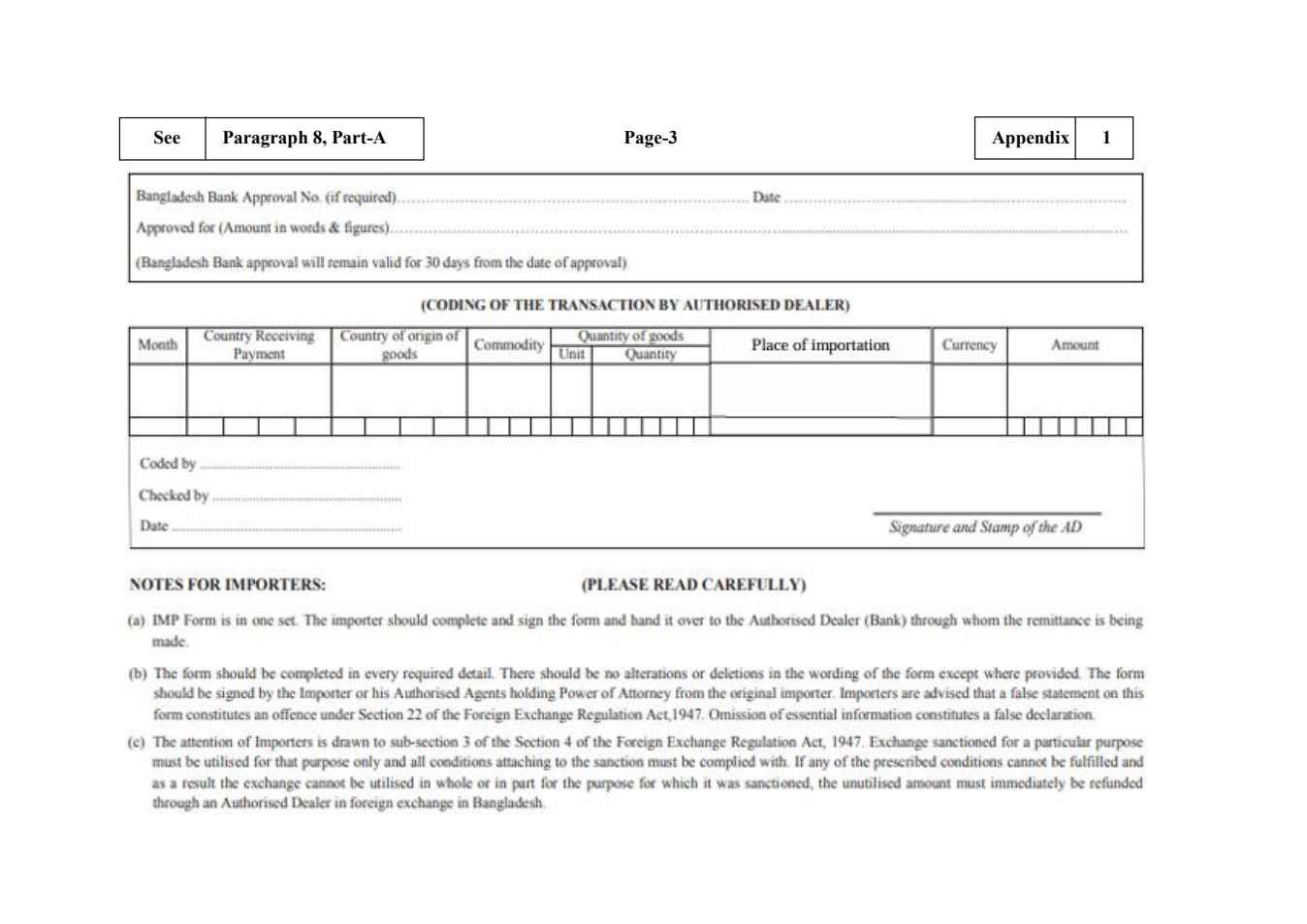
See Paragraph 8, Part-A Page-3 Appendix 1
See          Paragraph 9, Part-A


APPENDIX 2


List of Bangladesh Bank's
Offices and Their Jurisdictions
See          Paragraph 9, Part-A                                      Appendix       2

FOREIGN EXCHANGE POLICY DEPARTMENT,
BANGLADESH BANK, HEAD OFFICE, DHAKA
Dhaka
Narayanganj
Munshiganj
Narsingdi
Gazipur
Manikganj
Mymensingh
Netrokona
Kishoreganj
Tangail
Jamalpur
Sherpur
Faridpur
Rajbari
Brahmanbaria

BANGLADESH BANK, CHATTOGRAM
Chattogram
Cox’s Bazar
Bandarban
Rangamati
Khagrachhari
Noakhali
Feni
Laxmipur
Cumilla
Chandpur

BANGLADESH BANK, KHULNA
Khulna
Satkhira
Bagerhat
Jashore
Jhenaidah
Magura
Narail
Gopalganj
See          Paragraph 9, Part-A                      Appendix       2

BANGLADESH BANK, BARISHAL
Barishal
Jhalakathi
Barguna
Patuakhali
Pirojpur
Bhola
Shariatpur
Madaripur
BANGLADESH BANK, SYLHET
Sylhet
Sunamganj
Habiganj
Moulvibazar

BANGLADESH BANK, RAJSHAHI
Rajshahi
Natore
Chapainawabganj
Pabna
Kushtia
Meherpur
Chuadanga

BANGLADESH BANK, BOGURA
Bogura.
Joypurhat
Gaibandha
Sirajganj
Naogaon

BANGLADESH BANK, RANGPUR
Rangpur
Nilphamari
Lalmonirhat
Kurigram
Dinajpur
Panchagarh
Thakurgaon
FORM OF CERTIFICATE TO BE ISSUED BY THE AUTHORIZED DEALER IN CASE OF
IMPORT ON FOB BASIS/SIMILAR OTHER PERMISSIBLE ARRANGEMENTS WHERE
TRANSPORTATION CHARGES ARE TO BE PAID IN BANGLADESH TAKA /OTHER
CURRENCY.


Certificate
Certified that the amount of freight/transportation charges payable in…… …….(currency
name with amount) Eqv. BDT...……(Amount) as indicated in the Bill of Lading/ Airway Bill
No………………………dated the …….………………corresponding House Bill of Lading
No/House Airway Bill No …………………. dated the ....................... .......in respect of
……………………………………………………………………… …….imported by Messrs
…………………………………….……….from………………………………………...per s.s
…………………………………………….………………..……has been duly endorsed by us
 ……………….under our stamp and signature.


    Date: ……………………………………………..
See Paragraph 15, Part-A      Appendix 3
Signature of the bank official : …………………………………………………......
Name of the bank official : ……………………………………………………..
Designation : ……………………………………………………..
P.A No. : ……………………………………………………..
Contact Phone No. : ……………………………………………………..
Name of the AD : ……………………………………………………..
Stamp of the AD : ……………………………………………………..See Paragraph 12, Part-B Appendix 4
BANGLADESH BANK
FOREIGN EXCHANGE POLICY DEPARTMENT
FORM OF UNDERTAKING
(To be furnished by the importer for making advance remittances for permissible imports of goods and services).
In consideration of Bangladesh Bank permitting me/us an advance remittance of
.....................................to..................................................I/we hereby undertake that the amount
so remitted by me/us will be used solely for the purpose of payment for the goods/services described
below to be imported into Bangladesh from ...........................in accordance with the regulations
in force regarding such imports. I/We declare that the goods/services will be imported by me/us on or
about....................................... and I/we undertake to produce to the Bangladesh Bank documentary
evidence in respect of goods/services so imported including the authenticated copy of the Customs
Bill of Entry for goods and supplier's invoice in original. I/We further declare that the amount paid by
me/us in advance will be deducted from the invoice value of the goods (CFR)/services imported and
that the deduction will be shown on the invoice.
I/We do undertake to be held fully responsible under FER Act, 1947 if I/We fail to produce to the
Bangladesh Bank documentary evidence in respect of service or the Exchange Control Copy of the
Customs Bill of Entry in respect of goods in original within the stipulated time or bring back the remitted
foreign currency into Bangladesh as the case may be.
Name and address
of the supplier
Invoice Value Description Country of origin
Goods Services Goods Services Goods Services
Signature and Stamp of the Importer
Name of the Importer
Address
Registration Number with CCI & E
Signature and Stamp of the
Date....................................... Authorized Dealer……………………………..
(Name of the Bank)
STATEMENT OF CASES WITH MATERIAL DISCREPANCIES BETWEEN PARTICULARS IN IMPORT DOCUMENTS
AND IN THE AUTHENTICATED COPY OF BILL OF ENTRY/CUSTOMS CERTIFIED INVOICE
AS AT THE MONTH ENDED ON. .......................................
SL No.
Branch
Name
IMP Form NO.
Importer
name with
full
address
Importer IRC No. Item of
Import
LC
no.
&
Date
Invoice Value Amount Remitted Bill of Entry
(If Received)
Overd
ue
Value
Source of Foreign
Exchange( cash/
loan/grant etc.) Month of
return
schedule in
which the
transaction
reportted to
BB
Wheter
taken up
with the
Importer
(pl.
quote
letter
no.)
Explaination if any
submitted by importer
Reason for overdue
Remarks (if any)
AD
Code
Serial
No.
Year HS
Code
Name
Name of
Currency
Amount
(Eqv.
US$)
Name of
Currency
Amount
(Eqv.
US$)
Date Name of
Currency
Amount
(Eqv.
US$)
Amou
nt
(Eqv.
US$)
1 2 3 4 5 6 7 8 9 10 11 12 13 14 15 16 17
18
=(14-
17)
19 20 21 22 23 24
To
tal
We certify that all outstanding cases of material discrepancies in the import documents including those pending from the previous periods have been
listed in the above statement.
Name of the official : …………………………… Name of the official : ……………………………
Designation : …………………………… Designation : ……………………………
Contact No. : …………………………… Contact No. : ……………………………
See Paragraph 16 (3), Part-B Appendix 5See Paragraph 5(1), Part-E Appendix 6 MONTHLY SUMMARY STATEMENT OF OVERDUE ACCEPTED BILLS FOR THE MONTH OF ............................................. Bank Name ........................................................................................................................................ Sl Nature of bills Number of bills Bill value in Equivalent USD Remarks 1 Local Payables (excluding court case) 2 Unpaid Local Bills due to court case 3 Total Local Payables (1+2) 4 Foreign Payables (excluding court case) 5 Unpaid Foreign Bills due to court case 6 Total Forein Payables (4+5) 7 Local Receivables (excluding court case) 8 Unpaid Local Bills due to court case Total Local Receivables (7+8) Name of Authorized Personnel :………. Name of Authorized Personnel:………. Designation :……………………………… Designation :………………………… Contact No. :…………………………… Contact No. :…………………………
See Paragraph 5 (2), Part-E    Appendix 7


MONTHLY STATEMENT OF OVERDUE ACCEPTED BILLS (LOCAL PAYABLES)
FOR THE MONTH OF............................................................
   Bank Name: ………………………………………………………………………………………………………………………………………………………………….

Sl
No.
Name of
the LC
Issuing
Branch
LC/
Contract
Number
Quoted
Currency
LC/
Contract
Value (in
quoted
currency)
LC/Contract
Date
(dd/mm/yy)
Name of the
LC Advising
Bank &
Branch
Bill No. Quoted
Currency
Bill
Value
(in quoted
Currency)
Date of Bill
(dd/mm/yy)
Date of
Acceptance
(dd/mm/yy)
Date of
Maturity
(dd/mm/yy)
Delay
Days
Name of
the
Importer
Name of
the
Exporter
Reason
for
Overdue
Comments
(if any)


Total In Quoted Currency X =
Total In Quoted Currency Y =
Grand Total (in equivalent USD) =


Name of Authorized Personnel :…………………..  Name of Authorized Personnel:………………………………..
Designation :……………………………………… Designation :……………………………………………………
Contact No. :……………………………………… Contact No. :…………………………………………………….
See Paragraph 5 (3), Part-E    Appendix 8

MONTHLY STATEMENT OF OVERDUE ACCEPTED BILLS (FOREIGN PAYABLES)
FOR THE MONTH OF............................................................
Bank Name: ………………………………………………………………………………………………………………………………………………………………….

Sl
No.
Name of
the LC
Issuing
Branch
LC/
Contract
Number
Quoted
Currency
LC/
Contract
Value (in
quoted
currency)
LC/Contract
Date
(dd/mm/yy)
Name of the
LC Advising
Bank &
Branch
Bill No. Quoted
Currency
Bill
Value
(in quoted
Currency)
Date of Bill
(dd/mm/yy)
Date of
Acceptance
(dd/mm/yy)
Date of
Maturity
(dd/mm/yy)
Delay
Days
Name of
the
Importer
Name of
the
Exporter
Reason
for
Overdue
Comments
(if any)


Total In Quoted Currency X =
Total In Quoted Currency Y =
Grand Total (in equivalent USD) =


Name of Authorized Personnel : ..............................................


Name of Authorized Personnel : ..............................................
Designation : ..............................................................................

Designation : ..............................................................................
Contact Number : ......................................................................

Contact Number : ......................................................................
See Paragraph 5 (4), Part-E    Appendix 9


MONTHLY STATEMENT OF OVERDUE ACCEPTED BILLS (LOCAL RECEIVABLES)
FOR THE MONTH OF............................................................
Bank Name: ………………………………………………………………………………………………………………………………………………………………….

Sl
No.
Name of
the LC
Issuing
Branch
LC/
Contract
Number
Quoted
Currency
LC/
Contract
Value (in
quoted
currency)
LC/Contract
Date
(dd/mm/yy)
Name of the
LC Advising
Bank &
Branch
Bill No. Quoted
Currency
Bill
Value
(in quoted
Currency)
Date of Bill
(dd/mm/yy)
Date of
Acceptance
(dd/mm/yy)
Date of
Maturity
(dd/mm/yy)
Delay
Days
Name of
the
Importer
Name of
the
Exporter
Reason
for
Overdue
Comments
(if any)


Total In Quoted Currency X =
Total In Quoted Currency Y =
Grand Total (in equivalent USD) =


Name of Authorized Personnel :…………………..  Name of Authorized Personnel:………………………………..
Designation :……………………………………… Designation :……………………………………………………
Contact No. :……………………………………… Contact No. :…………………………………………………….
See                Paragraph 5(5), Part-E Appendix    10

   Page-01


MONTHLY BANK-WISE SUMMARY STATEMENT OF LOCAL OVERDUE
ACCEPTED BILLS FOR THE MONTH OF ............................................................


Bank Name : ......................................................................................................................................


Sl No.
Name of the Banks
Local Bills Payable Local Bills Receivable
Number Value (eqv. USD) Number Value (eqv. USD)


Name of Authorized Personnel : Name of Authorized Personnel :

Designation : ................................. Designation : ..................................

Contact Number :.......................... Contact Number : ...........................
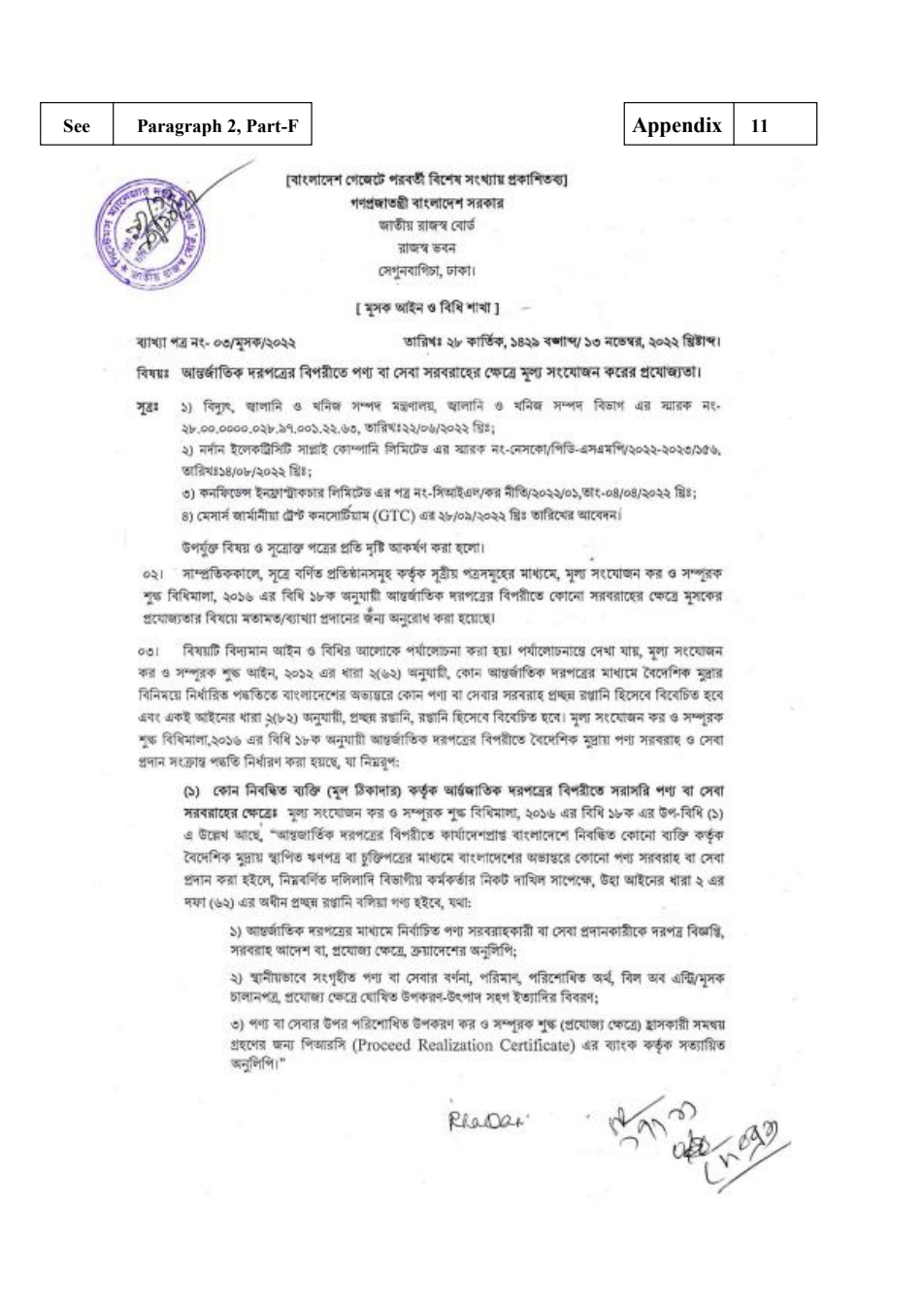
See Paragraph 2, Part-F Appendix 11
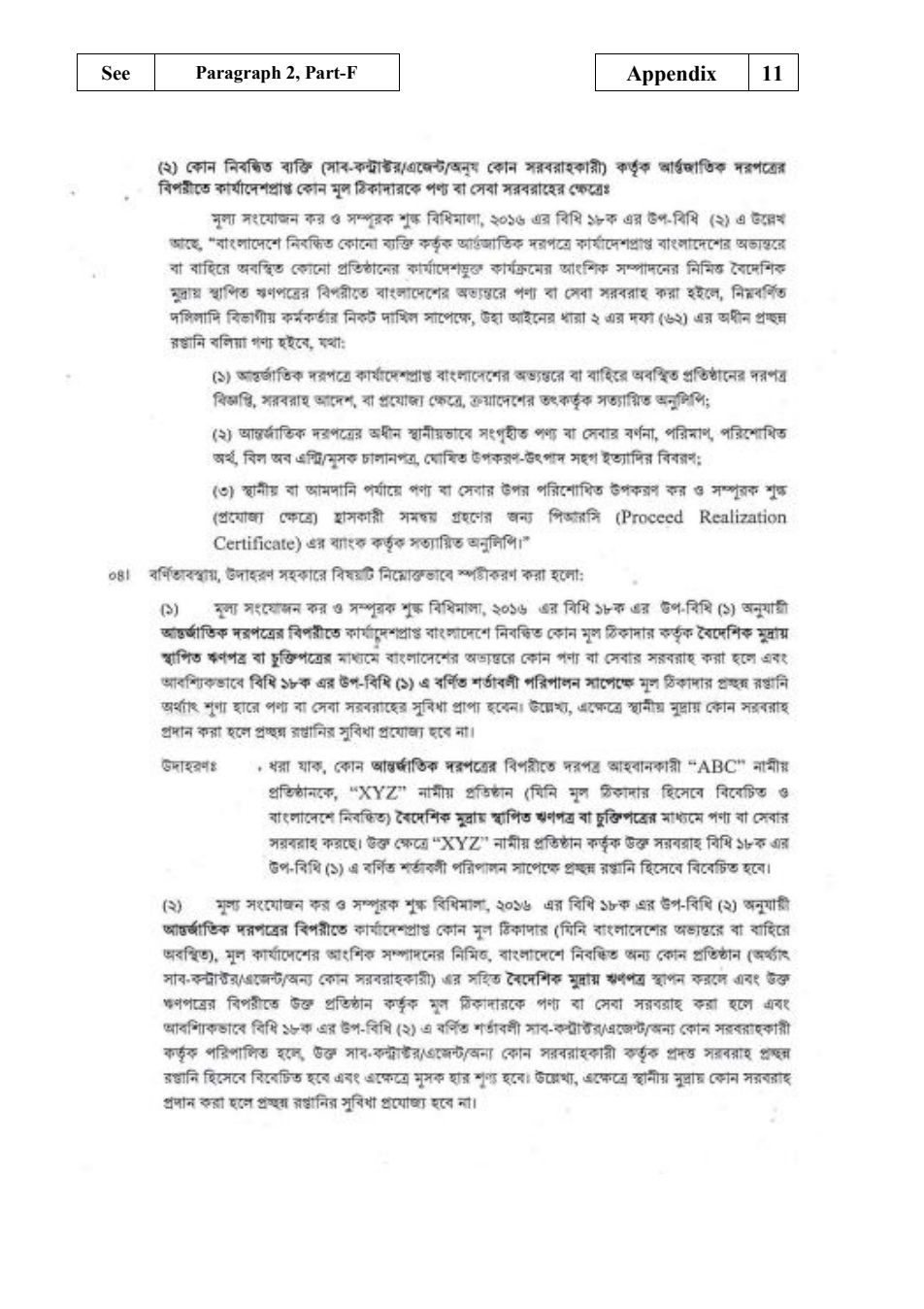
See Paragraph 2, Part-F Appendix 11
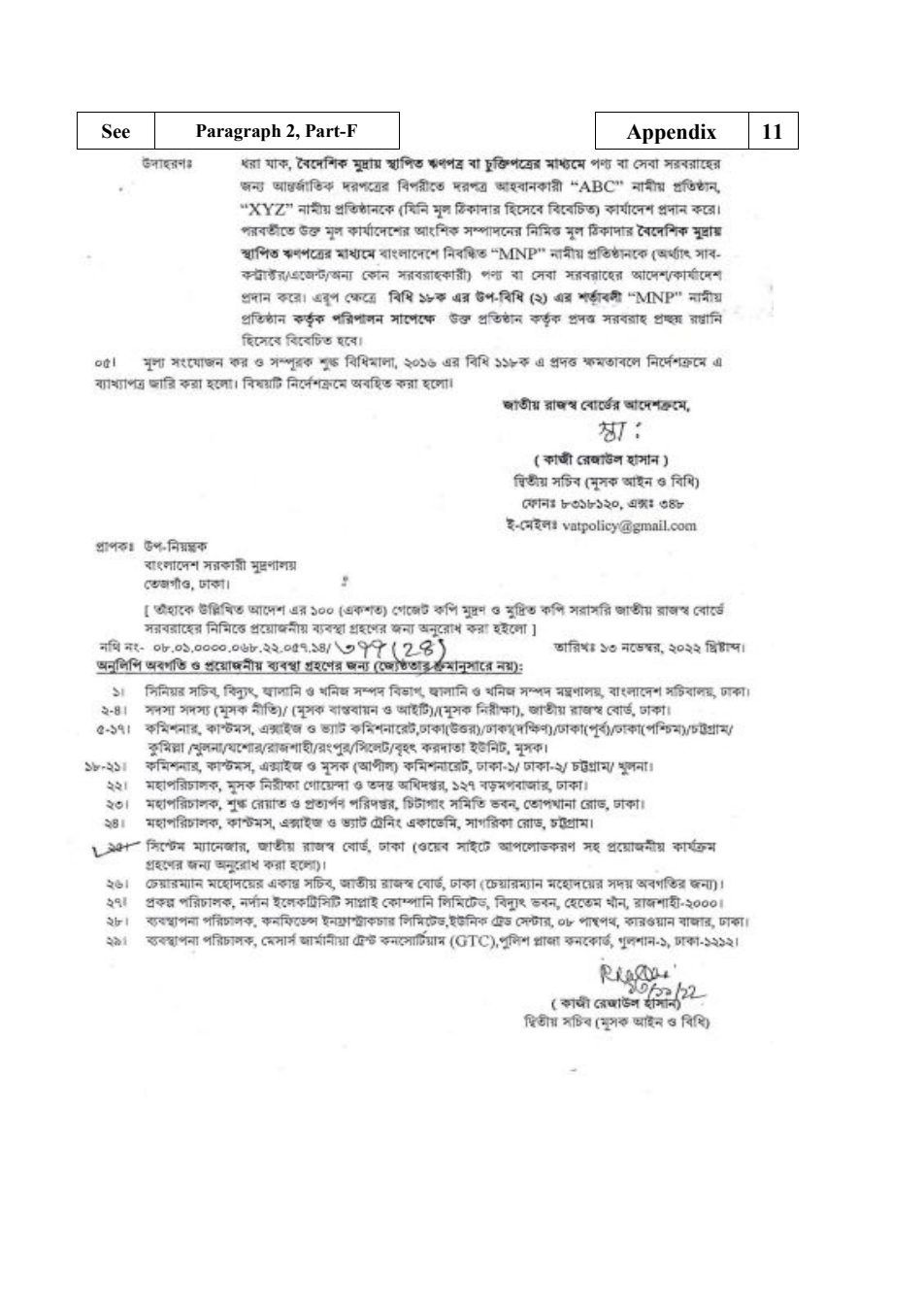
See Paragraph 2, Part-F Appendix 11
Forward Rate Agreements (FRAs) Weekly Repo


See Paragraph 5, Part-N  Appendix 12
Trade
 Date
FRA
Reference
No
Client
Name
FRA
Start
Date
FRA
Maturity
Date
Tenor
(e.g.
3x6)
Underlying
LC/Loan
Reference
No
Notional
Amount
Currency FRA
Contract
Rate
(%)
Benchmark
Rate
Fixed
Rate
Counter
Hedge
Rate
(%)
Bank
Spread
(bps)
Hedge
Counterparty
(Bank
Name)
Settlement
Amount
(by client
and bank)
Remarks
1 2 3 4 5 6 7 8 9 10 11 12 13 14 15 16 17
Monthly Return on Forward Rate Agreements(FRAs)


See Paragraph 5, Part-N  Appendix 13
FRA
Reference
No

Trade
Date
FRA
Maturity
Date
National
Amount
Benchmark
Rate
FRA
Contract
Rate (%)
Mtm Fixed
Rate
Counter
Hedge
Rate
(%)
Bank
Spred
(bps)
Hedge
Counterparty
(Bank Name)
Settlement
Amount
Settlement
paid by
client or
by bank
Counter
Hedge
Settlement
Amount
Counter
Hedge
Settlement
Received
or paid by
Bank
Net gain
/Loss of
Bank
from the
FRA
Remar
ks
                                             All Outstanding FRA                                                                                                                                                                              During the Reporting Month
1 2 3 4 5 6 7 8 9 10 11 12 13 14 15 16 17BANGLADESH BANK NOTIFICATION N0. FE-1/16-BB DATED JANUARY 20, 2016 (MAGH 07, 1422) IMPORT OF GOLD In exercise of the powers conferred by Section 8(1) of the Foreign Exchange Regulation Act, 1947 (VII of 1947) read with the erstwhile Central Government Notification No. l(2)-ECS/48 dated July 01, 1948, and in supersession of Bangladesh Bank's Notification No. FE -l/96-BB dated January 14, 1996, Bangladesh Bank has decided that incoming passengers irrespective of their resident status may bring into Bangladesh gold or silver in bullion/ingot form up to the prescribed limit in terms of relevant Baggage Rules in force issued under the Customs Act, 1969. (Nazneen Sultana) Deputy Governor See Paragraph 4, Part-O Appendix 14
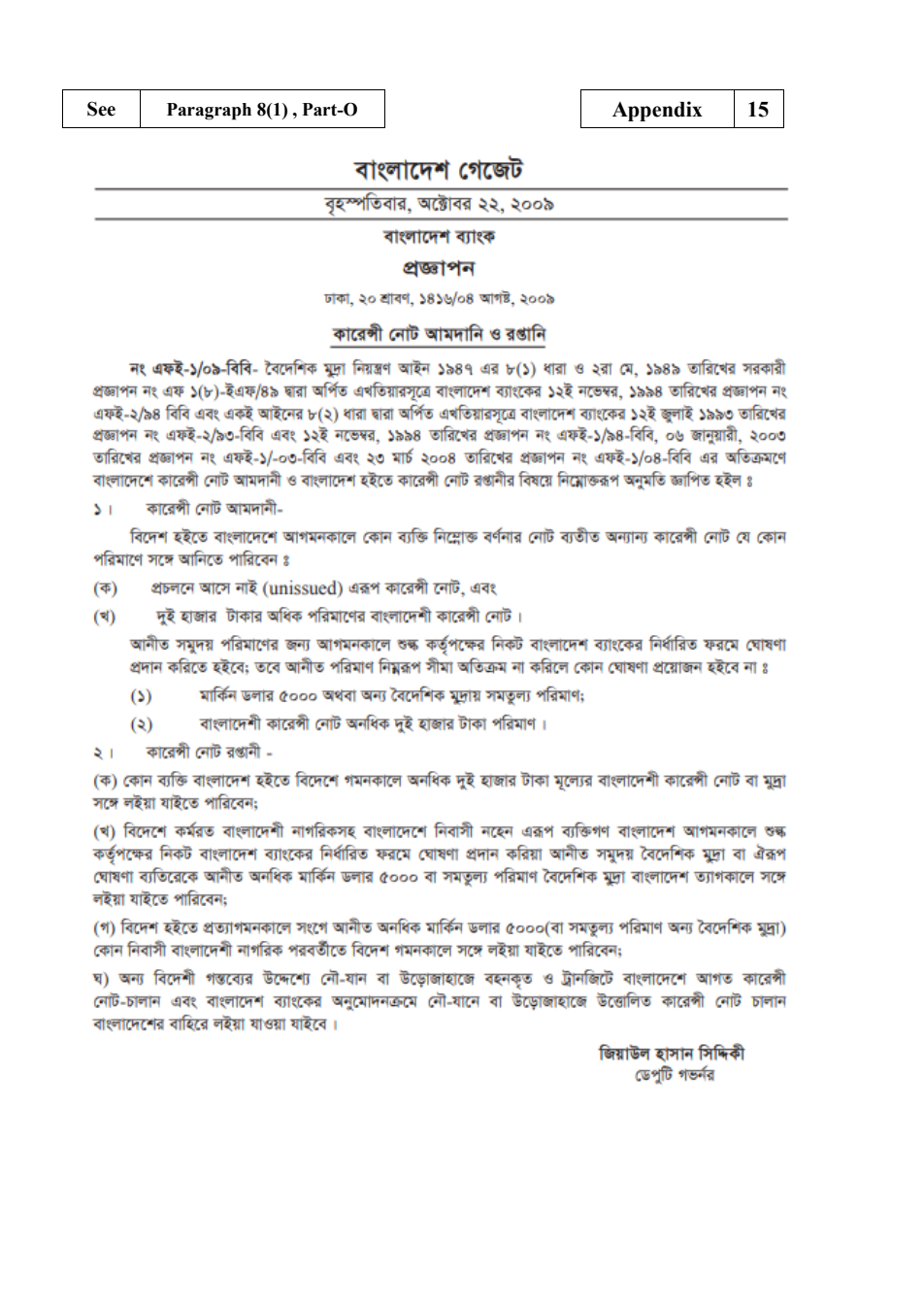
See Paragraph 8(1) , Part-O Appendix 15
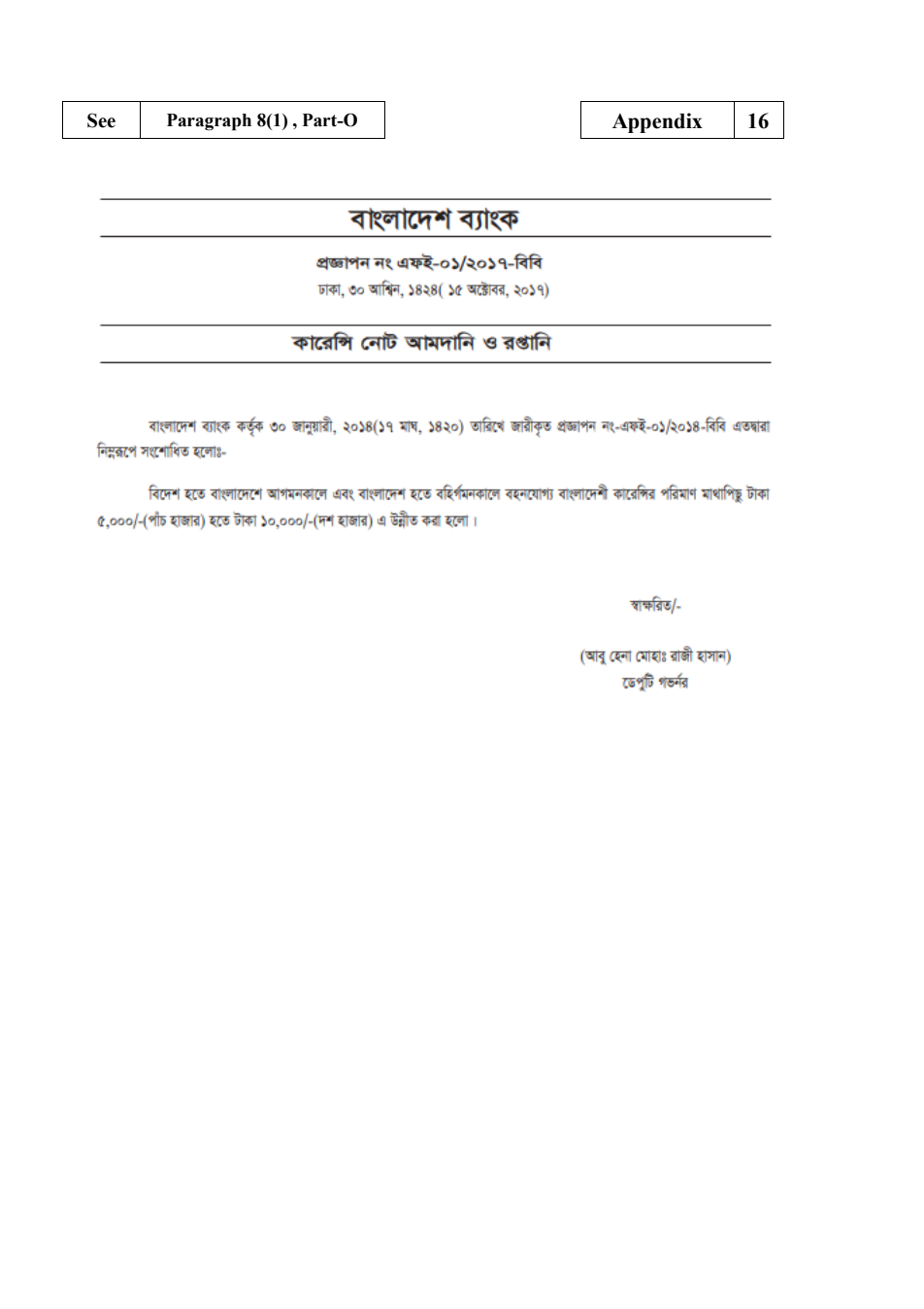
See Paragraph 8(1) , Part-O Appendix 16
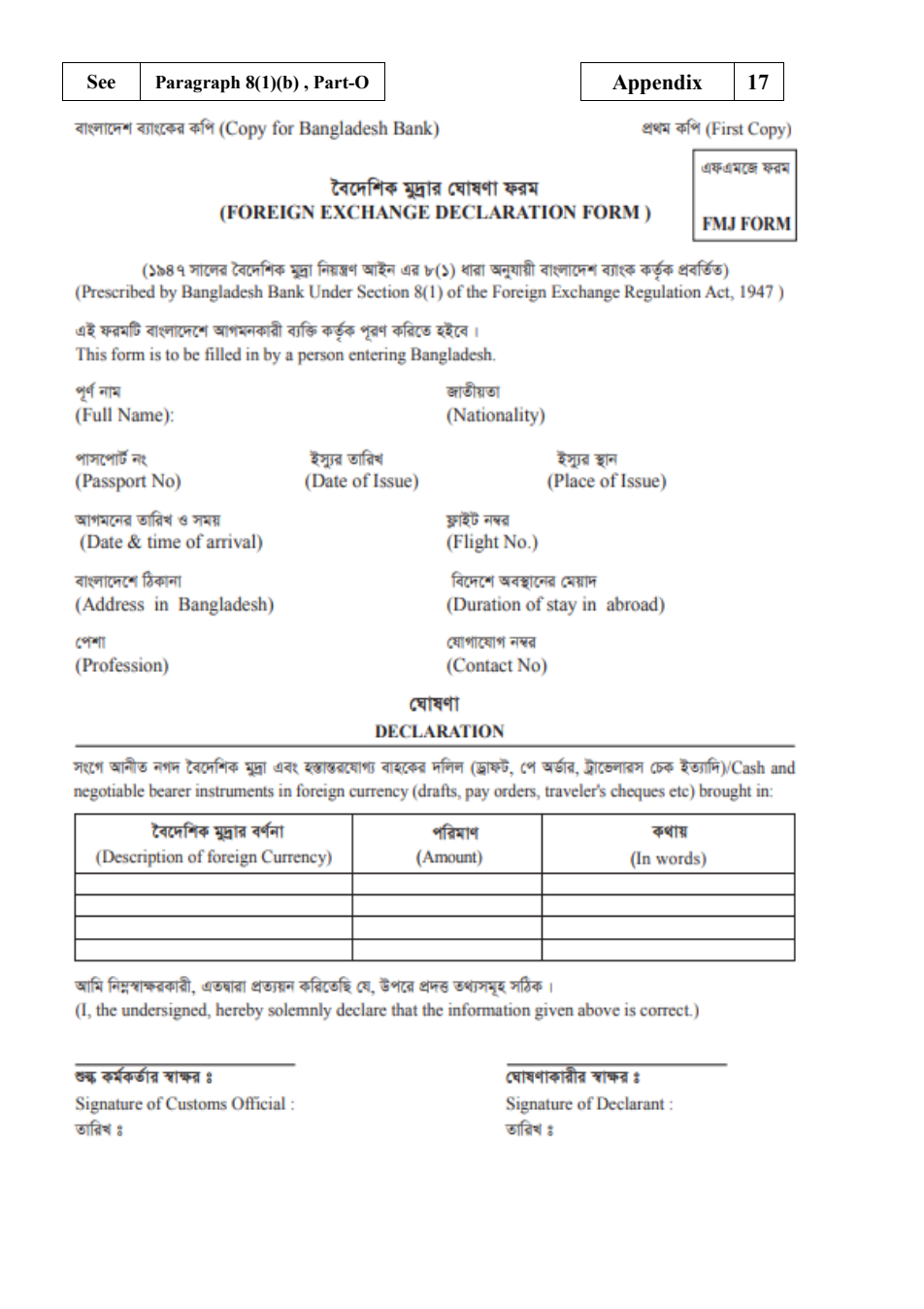
See Paragraph 8(1)(b) , Part-O Appendix 17
Page-2
Information for Declarant
(‡NvlYvKvixi Rb¨ ÁvZe¨)
1.  An incoming/outgoing passenger may bring in/take out  upto Taka 10,000(Ten thousand)
in Bangladesh currency at the time of arrival into/departure from Bangladesh.
1| evsjv‡`‡k AvMgb/evsjv‡`k nB‡Z ewnM©gbKv‡j †Kvb e¨w³ evsjv‡`kx gy`ªv AbwaK 10,000(`k nvRvi) UvKv
Avwb‡Z/jBqv hvB‡Z cvwi‡eb|
2. Any amount of foreig n currency may be brought in by an incoming passenger with
declaration to the customs authorities in Form FMJ. No declaration, however, is necessary
for amounts brought in upto US$ 10,000(Ten thousand) or equivalent. For a foreigner, the
entire amount brou ght in with declaration or upto US$ 10,000(Ten thousand) brought in
without declaration may be taken out freely at the time of departure. Upto US$ 10,000(Ten
thousand) brought in without declaration by a Bangladeshi may also be retained and taken
out freely while proceeding abroad. Amount in excess of US$ 10,000(Ten thousand) brought
in by the resident Bangladeshis, should, however, be encashed or deposited in appropriate
foreign currency account within 30  (thirty) days of arrival. Such amounts brought in b y non-
resident Bangladeshis can be encashed or deposited in foreign currency account any time
after return to Bangladesh.
2| ïé KZ…©c‡ÿi wbKU GdGg‡R di‡g †NvlYv cÖ`vb Kwiqv †h †Kvb cwigvY •e‡`wkK gy`ªv evsjv‡`‡k AvMgbKv‡j
m‡½ Avbv hvB‡Z cv‡i| Z‡e AvbxZ •e‡ `wkK gy`ªvi cwigvY AbwaK gvtWt 10000(`k nvRvi) ev mgZzj¨ nB‡j ïé
KZ…©c‡ÿi wbKU †NvlYv cÖ`vb Avek¨K nB‡e bv| we‡`kxM‡Yi †ÿ‡Î †NvlYv cÖ`vb Kwiqv AvbxZ mgy`q •e‡`wkK gy`ªv
Ges †NvlYv cÖ`vb e¨wZ‡i‡K AvbxZ AbwaK gvtWt 10000(`k nvRvi) evsjv‡`k Z¨vMKv‡j Aev‡a cÖZ ¨vevmb‡hvM¨
nB‡e| †NvlYv cÖ`vb e¨wZ‡i‡K AvbxZ AbwaK gvtWt 10000(`k nvRvi) evsjv‡`kx bvMwiKM‡Yi †ÿ‡ÎI m‡½
iÿY‡hvM¨ Ges evsjv‡`k nB‡Z ewn©MgbKv‡j m‡½ enb‡hvM¨ nB‡e; GZ`&wZwi³ †h †Kvb AsK wbevmx evsjv‡`kx‡`i
†ÿ‡Î evsjv‡`‡k AvMg‡bi 30  (wÎk) w`‡bi g‡a¨ UvKvq fv ½vB‡Z/cÖ‡hvR¨ ai‡Yi •e‡`wkK gy`ªv wnmv‡e Rgv Kwi‡Z
nB‡e| Awbevmx evsjv‡`kx KZ…©K AvbxZ GBiƒc AsK evsjv‡`‡k †diZ Avwmevi ci †h †Kvb mgq UvKvq fv½vB‡Z
cvwi‡eb A_ev •e‡`wkK gy`ªv wnmv‡e Rgv Kwi‡Z cvwi‡eb|
3. Encashment of foreign exchange brought in should be do ne with licenced Money
Changers/ Authorized Dealer bank branches.
3| m‡½ AvbxZ •e‡`wkK gy`ªv UvKvq bM`vqb jvB‡mÝ cÖvß gvwb‡PÄvi/Aby‡gvw`Z wWjvi e¨vsK kvLvi gva¨‡g m¤úv`b
Kwi‡Z nB‡e|
4. An incoming/outgoing adult female passenger may bring in/take out any quan tity of
personal jewellery worn on her person or as part of her accompanying personal baggage.
4|  evsjv‡`‡k AvMgb/evsjv‡`k nB‡Z ewnM©gbKv‡j †Kvb cÖvß eq¯‹v gwnjv hvÎx ¯^xq cwiav‡b A_ev e¨w³MZ
e¨v‡M‡Ri Askiƒ‡c †h †Kvb cwigvY e¨w³MZ AjsKvivw` m‡½ Avwb‡Z/jBqv hvB‡Z cvwi‡eb|
See Paragraph 8(1)(b) , Part-O  Appendix 17
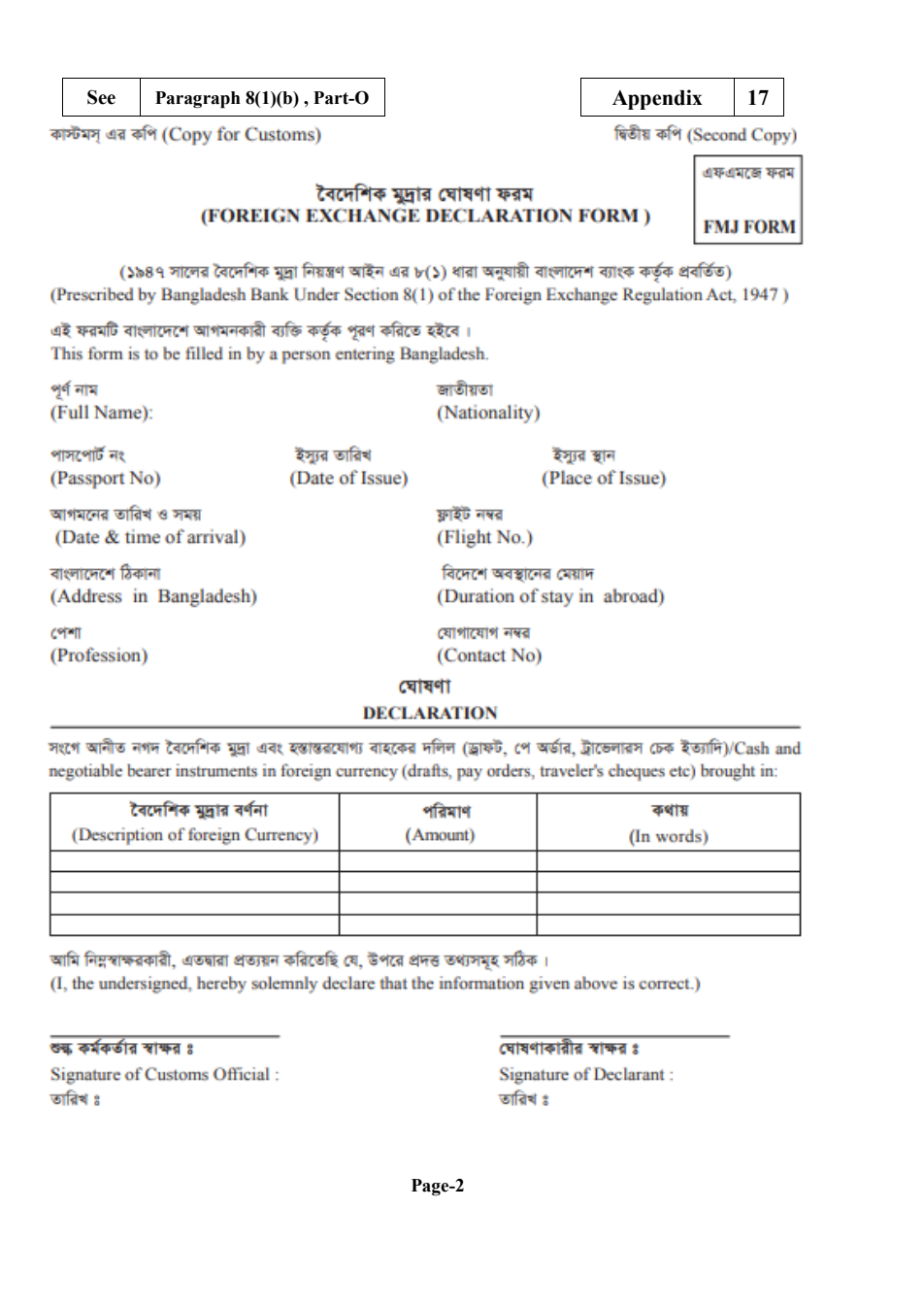
Page-2
See Paragraph 8(1)(b) , Part-O  Appendix 17
See Paragraph 8(1)(b) , Part-O  Appendix 17
Information for Declarant
(‡NvlYvKvixi Rb¨ ÁvZe¨)
1.  An incoming/outgoing passenger may bring in/take out upto Taka 10,000(Ten thousand)
in Bangladesh currency at the time of arrival into/departure from Bangladesh.
1| evsjv‡`‡k AvMgb/evsjv‡`k nB‡Z ewnM©gbKv‡j †Kvb e¨w³ evsjv‡`kx gy`ªv AbwaK 10,000(`k nvRvi) UvKv
Avwb‡Z/jBqv hvB‡Z cvwi‡eb|
2. Any amoun t of foreign currency may be brought in by an incoming passenger with
declaration to the customs authorities in Form FMJ. No declaration, however, is necessary
for amounts brought in upto US$ 10,000(Ten thousand) or equivalent. For a foreigner, the
entire amount brought in with declaration or upto US$ 10,000(Ten thousand) brought in
without declaration may be taken out freely at the time of departure. Upto US$ 10,000(Ten
thousand) brought in without declaration by a Bangladeshi may also be retained and take n
out freely while proceeding abroad. Amount in excess of US$ 10,000(Ten thousand) brought
in by the resident Bangladeshis, should, however, be encashed or deposited in appropriate
foreign currency account within 30 (thirty) days of arrival. Such amounts b rought in by non-
resident Bangladeshis can be encashed or deposited in foreign currency account any time
after return to Bangladesh.
2| ïé KZ…©c‡ÿi wbKU GdGg‡R di‡g †NvlYv cÖ`vb Kwiqv †h †Kvb cwigvY •e‡`wkK gy`ªv evsjv‡`‡k AvMgbKv‡j
m‡½ Avbv hvB‡Z cv‡i| Z‡ e AvbxZ •e‡`wkK gy`ªvi cwigvY AbwaK gvtWt 10000(`k nvRvi) ev mgZzj¨ nB‡j ïé
KZ…©c‡ÿi wbKU †NvlYv cÖ`vb Avek¨K nB‡e bv| we‡`kxM‡Yi †ÿ‡Î †NvlYv cÖ`vb Kwiqv AvbxZ mgy`q •e‡`wkK gy`ªv
Ges †NvlYv cÖ`vb e¨wZ‡i‡K AvbxZ AbwaK gvtWt 10000(`k nvRvi) evsjv‡`k Z¨vMKv‡ j Aev‡a cÖZ¨vevmb‡hvM¨
nB‡e| †NvlYv cÖ`vb e¨wZ‡i‡K AvbxZ AbwaK gvtWt 10000(`k nvRvi) evsjv‡`kx bvMwiKM‡Yi †ÿ‡ÎI m‡½
iÿY‡hvM¨ Ges evsjv‡`k nB‡Z ewn©MgbKv‡j m‡½ enb‡hvM¨ nB‡e; GZ`&wZwi³ †h †Kvb AsK wbevmx evsjv‡`kx‡`i
†ÿ‡Î evsjv‡`‡k AvMg‡bi 30  (wÎk) w`‡bi g‡a¨ UvKvq fv½vB‡Z/cÖ‡hvR¨ ai‡Yi •e‡`wkK gy`ªv wnmv‡e Rgv Kwi‡Z
nB‡e| Awbevmx evsjv‡`kx KZ…©K AvbxZ GBiƒc AsK evsjv‡`‡k †diZ Avwmevi ci †h †Kvb mgq UvKvq fv½vB‡Z
cvwi‡eb A_ev •e‡`wkK gy`ªv wnmv‡e Rgv Kwi‡Z cvwi‡eb|
1. Encashment of foreign exchange brought in s hould be done with l icenced Money
Changers/ Authorized Dealer bank branches.
3| m‡½ AvbxZ •e‡`wkK gy`ªv UvKvq bM`vqb jvB‡mÝ cÖvß gvwb‡PÄvi/Aby‡gvw`Z wWjvi e¨vsK kvLvi gva¨‡g m¤úv`b
Kwi‡Z nB‡e|
2. An incoming/outgoing adult female passenger may bring in/take out any quantity of
personal jewellery worn on her person or as part of her accompanying personal baggage.
4|   evsjv‡`‡k AvMgb/evsjv‡`k nB‡Z ewnM©gbKv‡j †Kvb cÖvß eq¯‹v gwnjv hvÎx ¯^xq cwiav‡b A_ev e¨w³MZ
e¨v‡M‡Ri Askiƒ‡c †h †Kvb cwigvY e¨w³MZ AjsKvivw` m‡½ Avwb‡Z/jBqv hvB‡Z cvwi‡eb|


See Paragraph 8(1)(b) , Part-O  Appendix 17 See Paragraph 8(1)(b) , Part-O  Appendix 17
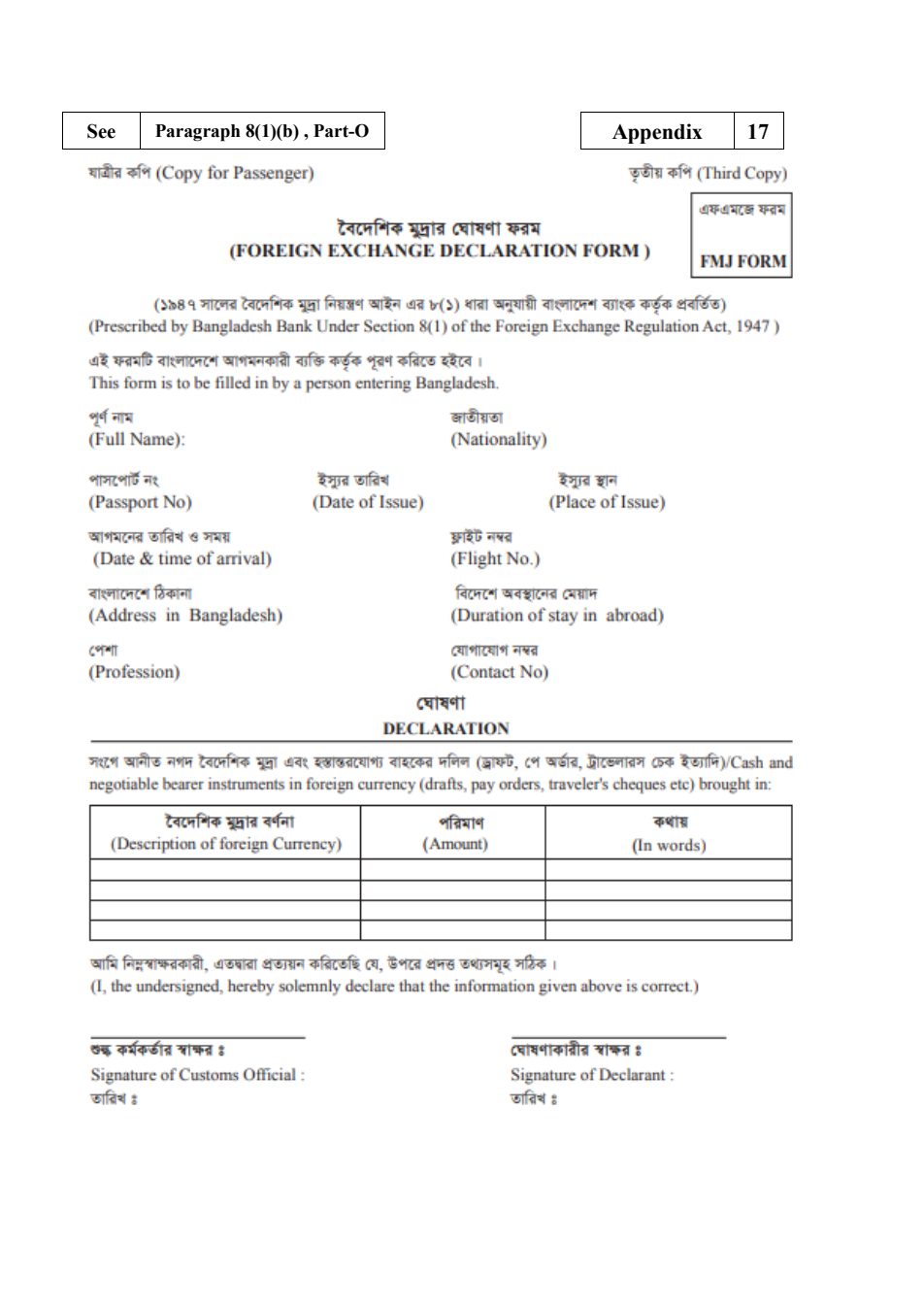
See Paragraph 8(1)(b) , Part-O Appendix 17
Page-2
Information for Declarant
(‡NvlYvKvixi Rb¨ ÁvZe¨)
1.  An incoming/outgoing passenger may bring in/take out upto Taka 10,000(Ten thousand)
in Bangladesh currency at the time of arrival into/departure from Bangladesh.
1| evsjv‡`‡k AvMgb/evsjv‡`k nB‡Z ewnM©gbKv‡j †Kvb e¨w³ evsjv‡`kx gy`ªv AbwaK 10,000(`k nvRvi) UvKv
Avwb‡Z/jBqv hvB‡Z cvwi‡eb|
3. Any amount of foreign currency may be brought in by an incoming passenger
with declaration to the customs authorities in Form FMJ. No declaration, however, is
necessary for amounts brought in upto US$ 10,000(Ten thousand) or equivalent. For a
foreigner, the entire amount brought in with declaration or upto US$ 10,000(Ten
thousand) brought in without declaration may be taken out freely at the time of departure.
Upto US$ 10,000(Ten thousand) brought in without declaration by a Bangladeshi may
also be retained and taken out freely while proceeding abroad. Amount in excess of US$
10,000(Ten thousand) brought in by the resident Bangladeshis, should, however, be
encashed or deposited in appropriate foreign currency account within 30  (thirty) days of
arrival. Such amounts brought in by non -resident Bangladeshis can be encashed or
deposited in foreign currency account any time after return to Bangladesh.
2| ïé KZ…©c‡ÿi wbKU GdGg‡R di‡g †NvlYv cÖ`vb Kwiqv †h †Kvb cwigvY •e‡`wkK gy`ªv evsjv‡`‡k AvMgbKv‡j
m‡½ Avbv hvB‡Z cv‡i| Z‡e AvbxZ •e‡`wkK gy`ªvi cwigvY AbwaK gvtWt 10000(`k nvRvi) ev mgZzj¨ nB‡j ïé
KZ…©c‡ÿi wbKU †NvlYv cÖ`vb Avek¨K nB‡e bv| we‡`kxM‡Yi †ÿ‡Î †NvlYv cÖ`vb Kwiqv AvbxZ mgy`q •e‡`wkK gy`ªv
Ges †NvlYv cÖ`vb e¨wZ‡i‡K AvbxZ AbwaK gvtWt 10000(`k nvRvi) evsjv‡`k Z¨vMKv‡j Aev‡a cÖZ¨vevmb‡hvM¨
nB‡e| †NvlYv cÖ`vb e¨wZ‡i‡K AvbxZ AbwaK gvtWt 10000(`k nvRvi) evsjv‡`kx bvMwiKM‡Yi †ÿ‡ÎI m‡½
iÿY‡hvM¨ Ges evsjv‡`k nB‡Z ewn©MgbKv‡j  m‡½ enb‡hvM¨ nB‡e; GZ`&wZwi³ †h †Kvb AsK wbevmx evsjv‡`kx‡`i
†ÿ‡Î evsjv‡`‡k AvMg‡bi 30  (wÎk) w`‡bi g‡a¨ UvKvq fv½vB‡Z/cÖ‡hvR¨ ai‡Yi •e‡`wkK gy`ªv wnmv‡e Rgv Kwi‡Z
nB‡e| Awbevmx evsjv‡`kx KZ…©K AvbxZ GBiƒc AsK evsjv‡`‡k †diZ Avwmevi ci †h †Kvb mgq UvKvq fv ½vB‡Z
cvwi‡eb A_ev •e‡`wkK gy`ªv wnmv‡e Rgv Kwi‡Z cvwi‡eb|
4. Encashment of foreign exchange brought in should be done with l icenced Money
Changers/ Authorized Dealer bank branches.
3| m‡½ AvbxZ •e‡`wkK gy`ªv UvKvq bM`vqb jvB‡mÝ cÖvß gvwb‡PÄvi/Aby‡gvw`Z wWjvi  e¨vsK kvLvi gva¨‡g m¤úv`b
Kwi‡Z nB‡e|
5. An incoming/outgoing adult female passenger may bring in/take out any quantity of
personal jewellery worn on her person or as part of her accompanying personal baggage.
4|   evsjv‡`‡k AvMgb/evsjv‡`k nB‡Z ewnM©gbKv‡j †Kvb cÖvß eq¯‹v gwnjv hvÎx ¯^xq cwiav‡b A_ev e¨w³MZ
e¨v‡M‡Ri Askiƒ‡c †h †Kvb cwigvY e¨w³MZ AjsKvivw` m‡½ Avwb‡Z/jBqv hvB‡Z cvwi‡eb|
See Paragraph 8(1)(b) , Part-O  Appendix 17
STATEMENT OF L/C OPENED UNDER LOANS/CREDITS/GRANTS
REQUIRING DEPOSITS OF COUNTERPART TAKA FOR THE MONTH
OF……………………………..
Name of the Designated Bank………………………………………………………………………………………………………………………
Sl. No L/C No. &
Date
Name &
address of
importer
Identifying name
of
Loan/Credit/grant
under which L/C
was opened
Amount of L/C opened
Last date
of
shipment
under the
L/C
Probable date
of receipt of
import
document in
Bangladesh
Indicate the
arrangements
made with
importer for
deposit of
Counterpart
Funds on receipt
of import
documents
Any other
remark In foreign
currency
In
Bangladeshi
Taka
1 2 3 4 5 6 7 8 9 10

(To be submitted to the Bangladesh Bank by the 15th of every month).


       Seal & Signature of the Designated Bank
See Paragraph 5(2)(a) , Part-P Appendix 18STATEMENT OF DISCREPANT BILLS RECEIVED ON COLLECTION BASIS Sl No. Name & Address of the importer Name & address of importer's bank Bill No. & date Identification of the loan/ credit/grant Description of goods Date of receipt of the document by designated bank Date of acceptance of document Bill Amount Foreign currency Rate of exchange applied Bangladesh Taka 1 2 3 4 5 6 7 8 9 10 11 See Paragraph 5(2)(b) , Part-P Appendix 19 Signature & Seal of the Date……………………….. Designated Bank
STATEMENT OF DEPOSIT OF COUNTERPART TAKA FUNDS


Sl
No.

Name &
Address of the
importer
LC
No. &
Date
Identification of
the loan/
credit/grant
Descriptio
n of
goods
Date of
negotiation of
bills/document
Date of
receipt of
of
document
in
Bangladesh
Bill
No. &
date

Bill Amount* Date of
deposit of
Counterpart
Taka funds

Reasons for
delay, if
any, in
depositing
counterpart
Taka funds
Foreign
currency
Rate of
exchange
applied
Bangladesh
Taka
1 2 3 4 5 6 7 8 9 10 11 12 13


* If forward cover is taken, indicate the month in which the forward sale has been reported as per para graph 8 of Chapter - 4, section -II of Guidelines for
Foreign Exchange Transaction, 2018.


 Signature & Seal of the
Date………………………..     Designated Bank

See Paragraph 5(3) , Part-P  Appendix 20
No matching page. Try a shorter word or show all pages.